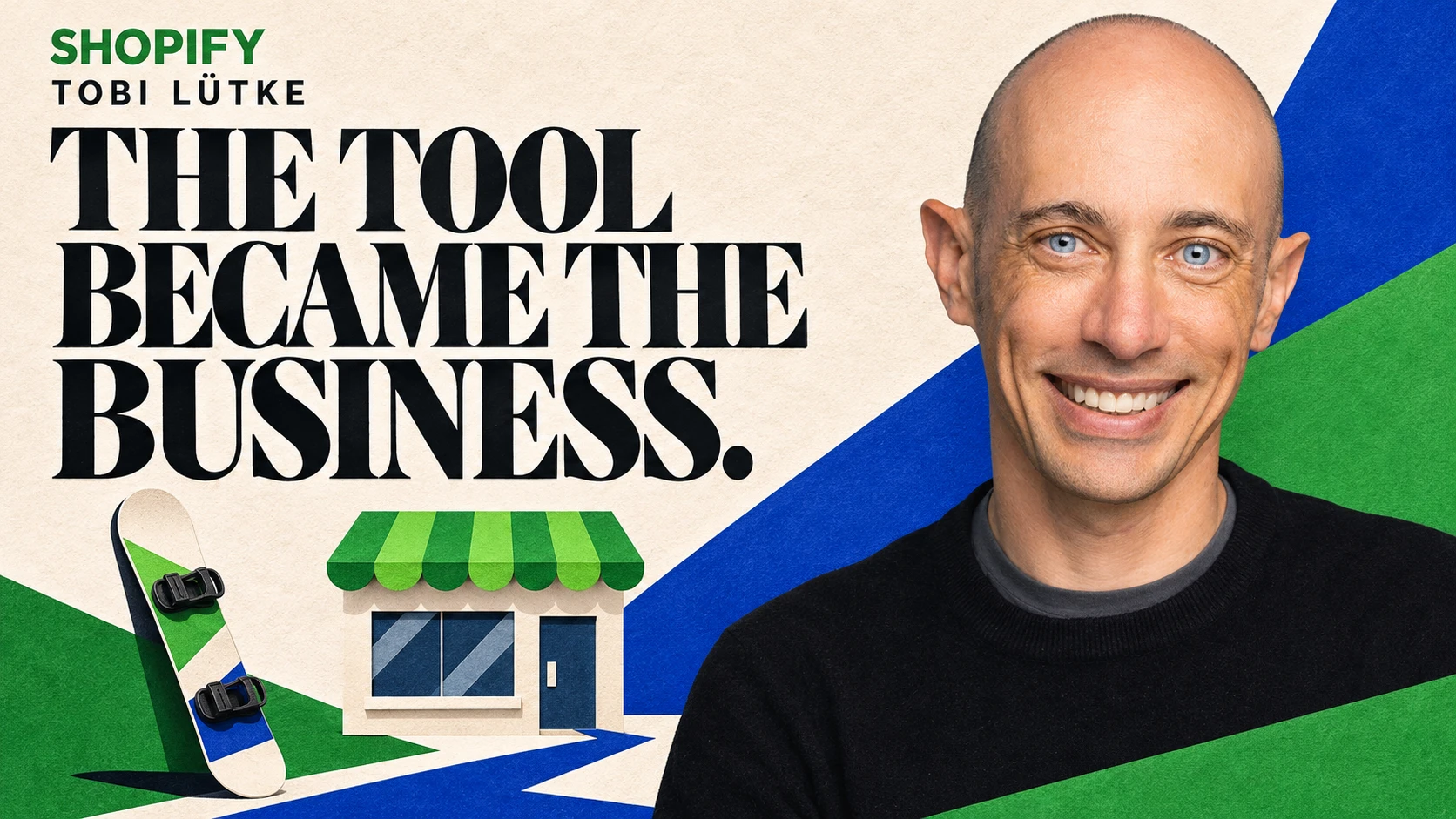
Who is Tobi Lütke?
Tobi Lütke’s account of Shopify’s origins starts with a merchant’s frustration. The software built to address it became a business opportunity of its own. His story offers a useful question for founders: when does an internal solution deserve a separate customer?
- Founder profiled
- Tobi Lütke
- Company or institution
- Shopify
- Reading lens
- SaaS & software
Source starting point: Tobi Lütke: 100,000 Online Stores Now Use Shopify — 22 April 2014 ↗. Full sources and context appear below.
A merchant’s problem came first
In his 22 April 2014 post, Tobi Lütke recalled wanting to sell snowboards online and finding shopping-cart options too expensive or too complicated. He described that frustration as the starting point for Shopify and its effort to make running an online store easier.
The important shift is in the identity of the customer. Selling snowboards serves the person buying equipment. Providing commerce software serves the merchant trying to sell it. The same working experience can reveal both problems, but the businesses require different promises, support and routes to customers.
Our reading of the origin story is that an internal tool can reveal an opportunity adjacent to the original venture. It does not follow that every frustrating task should become a software company. The next question is whether the difficulty repeats for people outside the team.
Keep the chronology in view
Shopify’s current governance page identifies Lütke as a co-founder dating to September 2004 and says he has been CEO since April 2008, following his role as CTO. A Shopify article published on 5 December 2024 revisits his Snowdevil experience and his decision to consider offering the software to others.
Those dates matter because a retrospective compresses years of work into a readable sequence. An origin story can explain the starting insight without documenting every experiment, contribution or commercial decision that followed. Treat it as evidence of the problem the founder encountered, rather than a complete recipe for recreating the outcome.
This profile uses Lütke’s perspective to examine that transition. It does not imply that he built the company alone or that the original software was already the platform a merchant would encounter today.
Separate shared friction from your own preferences
If your team has built a useful workaround, list the assumptions embedded in it. It may depend on your data format, an unusually capable operator or a process that exists only in your company. These details are easy to miss when the builder is also the user.
Ask another team to describe how it handles the same task before showing your solution. Compare the sequence of work, the people involved and what happens when something goes wrong. A similar complaint may hide a different workflow. Conversely, a small repeated obstacle may matter more than the large feature you are proudest of.
A practical test is to name the part that stays useful when your own company’s context is removed. That is the candidate product. The remaining custom work may still be valuable, but it needs to be counted honestly when deciding what you could support for others.
The handover is part of the product
A tool that works while its creator is nearby has not yet demonstrated that another customer can use it independently. Watch where a new user needs help: setup, importing information, understanding a label, recovering from an error or deciding which result to trust.
For a founder, these moments reveal the work hidden behind a successful demonstration. Record the explanation each user needs and decide whether it belongs in the product, documentation or a service you intend to provide. Do not treat all assistance as a temporary inconvenience if it is essential to the outcome.
Our suggested measure is a completed customer task under realistic conditions. A person praising a demo and a person successfully using the tool in their own work are different observations. Both can be useful, but they answer different questions.
Small improvements can carry the strategy
In the December 2024 Shopify interview article, Lütke described innovation in terms of frequent incremental improvements rather than a single dramatic breakthrough. The piece connects that view to developing a craft and making things better through sustained work.
For a small software team, that suggests a concrete operating discipline: choose one repeated customer difficulty, make a change and observe whether the task becomes easier. Keep a record of what the change was supposed to improve. Adding a feature and reducing the effort required to complete a task are not automatically the same result.
The point is not to avoid ambitious plans. It is to connect them to improvements a customer can experience. A broad product vision becomes more useful when the team can identify which small piece of work should happen next and why.
An origin story is a starting question
Lütke’s 2014 post was written to mark Shopify reaching 100,000 businesses using its service. That number belongs to the announcement dated 22 April 2014; it is not a current company total. Looking back from that milestone makes the earlier insight seem especially clear.
A founder making a decision now does not have that hindsight. Before turning an internal tool into a separate offer, identify the customer, the task and the support obligation. Decide what evidence would justify another step and what would lead you to keep the tool internal.
The useful lesson is the change in attention: a difficulty encountered while operating one business may reveal a different business worth investigating. The investigation still has to establish who needs it, how they will use it and what it takes to deliver reliably.
Audit one internal tool
Use these questions to investigate the idea in your own context.
- Name the repeated task the tool helps your team complete.
- List the assumptions specific to your company.
- Observe how another team handles the same task.
- Try a bounded handover and record every point requiring help.
- Decide whether the evidence supports a product, a service or keeping it internal.
A closer look
Is this a new Shopify announcement?
No. It is a retrospective published on 13 November 2026, using explicitly dated historical accounts and a current governance page.
Does the article profile all Shopify co-founders?
No. It examines Tobi Lütke’s published account and perspective. It is not a complete founding-team history.
Should every useful internal tool become a product?
No. Our suggested test is whether the task and solution transfer to another customer at a support level the business can sustain.
Sources & editorial note
Independent retrospective researched on 13 November 2026 from Shopify’s current governance page, Lütke’s 22 April 2014 post and a Shopify interview article published on 5 December 2024. These are historical accounts, not new announcements. This profile focuses on Lütke’s decisions, not a complete history of the founding team. The practical framework is Founderline analysis; no original interview or sponsorship is implied.
- Tobi Lütke: 100,000 Online Stores Now Use Shopify — 22 April 2014
- Shopify: Board of Directors, Tobi Lütke biography and portrait — checked 13 November 2026
- Shopify: Tobi Lütke, founder’s success advice — 5 December 2024
See our editorial standards or request a correction. For a useful comparison, read Joel Gascoigne’s Buffer: what the first customer test really proved. Explore the founder topic guides for connected reading paths.