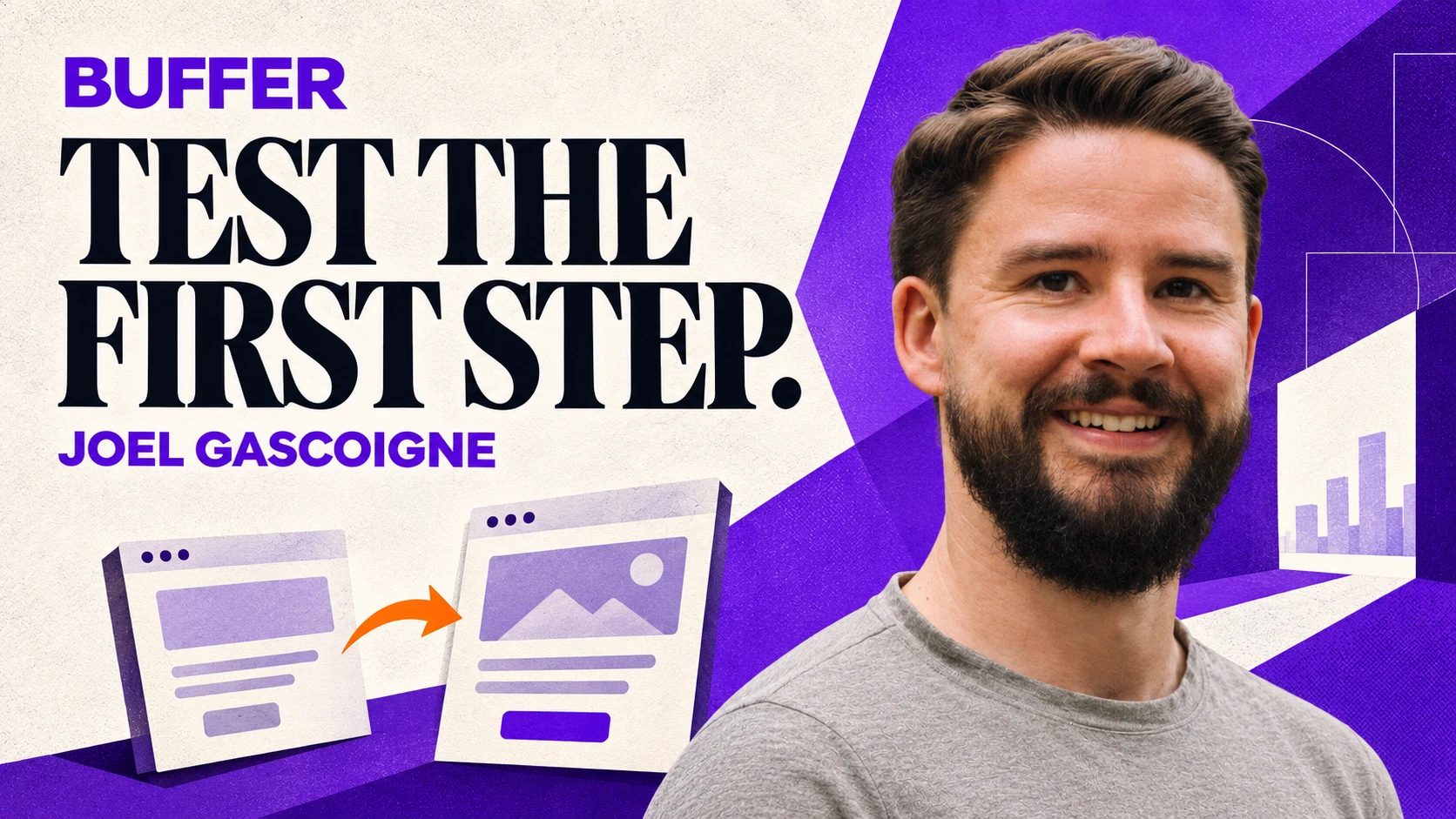
Who is Joel Gascoigne?
Joel Gascoigne’s account of starting Buffer separates interest in an idea from use of a working product. His early tests and later reflections offer founders a practical way to ask what they have learned, what remains uncertain and when the next task should change from building to reaching customers.
- Founder profiled
- Joel Gascoigne
- Company or institution
- Buffer
- Reading lens
- SaaS & software
Source starting point: Buffer: About us, company story and Joel Gascoigne’s official portrait — checked 10 November 2026 ↗. Full sources and context appear below.
Start with the task the founder could describe
Buffer’s current company page identifies Joel Gascoigne as its CEO and co-founder. Its account of the company’s beginning describes a desire to space out tweets, which became a Startup Sprint project in November 2010. The page now describes a broader social-media business serving creators, small businesses and individuals.
The distance between that starting task and the current product is worth keeping visible. A founder looking for an initial customer does not have to explain a complete future platform. A concrete task gives a prospective user something to recognise: the situation, the inconvenience and the result they want. It also gives the founder a smaller question to investigate.
The early test was a sequence of questions
In a post dated 16 February 2011, Gascoigne described stopping development to test interest through a two-page site. He shared the link on Twitter and received email signups and feedback. He then inserted a pricing page and observed which plans visitors selected before leaving an email address. Some selected paid plans.
Those actions provide different kinds of evidence. A signup suggests interest in hearing more. Selecting a paid plan adds information about a stated price, but does not establish that money changed hands or that someone will keep using a product. Our reading is that the value of a small test lies in choosing the next investigation, rather than declaring the entire business proven.
A launch creates a different kind of evidence
Gascoigne’s 30 November 2020 retrospective dates Buffer’s launch to 30 November 2010. He recalled receiving the first paying customer within four days and then shifting more attention towards marketing and customer development. He also explained that bringing on a co-founder followed that need to balance the work.
Payment for a working product is a different event from selecting a price on a preliminary page. Even payment leaves questions open: did the customer complete the task, return to it, and continue paying? For a founder, the next useful measurement should follow the uncertainty. Once some people can obtain value, endlessly adding features may teach less than finding out why similar people have not tried the product.
Keep the test honest and the result interpretable
For anyone adapting this approach now, make clear what is available and what is still being tested. A visitor should understand whether they are joining a notification list, applying for a pilot or purchasing access. State what happens after they submit their details. This is Founderline’s recommended approach, not a claim about every detail of Buffer’s original pages.
Define what you will record before sharing the test: where visitors came from, which action they took and the questions they asked. Separate responses from friends or an existing audience from those of unfamiliar potential customers. A test can be useful with a small group, but its audience limits what the result says about broader demand.
Use a deadline to expose a tradeoff
In the 2011 account, Gascoigne described building during evenings and weekends and using the end of November as a launch cutoff. Some intended features were left out. The deadline forced a choice about what belonged in the first working version.
Our practical interpretation is to define a complete customer outcome before cutting scope. Remove optional breadth while retaining what is needed to deliver the promise, explain limitations and support the user. A product can be narrow without being confusing about what it does. Before launch, ask a person outside the build process to attempt the core task and describe where they get stuck.
An early success does not settle later decisions
Gascoigne’s 2020 retrospective also describes later experiments that were reconsidered, including Buffer’s move towards self-management and its subsequent move away from that structure. The founder account presents organisational choices as things the team learned through, rather than as a fixed formula established at launch.
That is a useful boundary on the familiar startup origin story. An effective early test does not automatically validate a future team structure, a new customer segment or an expanded product. Each changes the question. Keep a short record of the assumption, the evidence and the decision made at that stage, so an old success does not become the explanation for every later choice.
Turn the story into your next decision
Choose one assumption currently delaying your work. It might concern whether the problem recurs, whether a price is understandable or whether users can complete the task. Design a small observation that bears directly on that assumption and decide what you would do with each plausible result.
Avoid making the test responsible for proving everything. Interest, purchase, successful use and continued use belong to different points in the customer journey. Gascoigne’s account is most useful when it prompts that discipline: name what the evidence supports, then choose the next step it leaves unresolved.
Write a one-question customer test
Use these questions to investigate the idea in your own context.
- State one uncertainty in a sentence, without describing your entire business.
- Choose the customer group and record how you will reach it.
- Explain honestly what is available and what the participant is being asked to do.
- Define the observation that would support, weaken or leave your assumption unresolved.
- Record the result and choose the next investigation rather than declaring the whole idea validated.
A closer look
When did Buffer launch?
Gascoigne dates the first product launch to 30 November 2010 in his ten-year retrospective. This article is a historical analysis published on 10 November 2026.
Did clicking a paid plan mean someone had paid?
No. The preliminary pricing-page behaviour in Gascoigne’s account is distinct from his report of a paying customer after the working product launched.
Is this a complete account of Buffer’s founding team?
No. It focuses on Gascoigne’s published account of early testing and development decisions. His retrospective also acknowledges bringing on a co-founder as the work expanded.
Sources & editorial note
Independent retrospective researched on 10 November 2026 using Gascoigne’s own Buffer posts and the company’s current About page. Buffer launched on 30 November 2010; that is a historical milestone, not a new announcement or an anniversary occurring today. This profile focuses on Joel Gascoigne’s early decisions rather than presenting a complete history of Buffer’s founding team. The interpretations and exercise are Founderline analysis. No original interview or sponsorship is implied.
- Buffer: About us, company story and Joel Gascoigne’s official portrait — checked 10 November 2026
- Joel Gascoigne: Idea to Paying Customers in 7 Weeks — 16 February 2011
- Joel Gascoigne: Reflecting on 10 Years of Building Buffer — 30 November 2020
See our editorial standards or request a correction. For a useful comparison, read Tope Awotona and the scheduling problem worth building for. Explore the founder topic guides for connected reading paths.