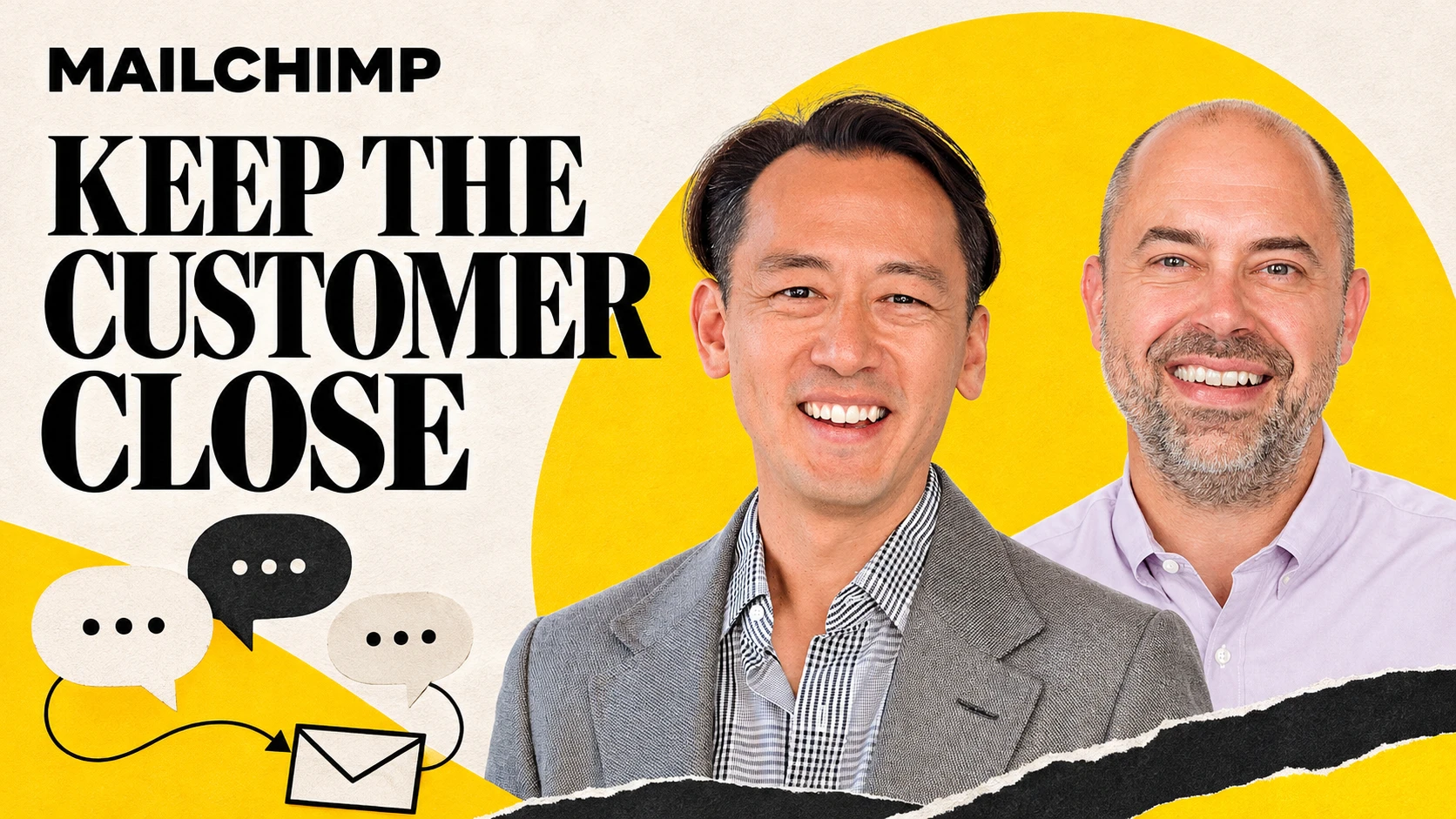
Who is Ben Chestnut and Dan Kurzius?
Customer focus becomes useful when someone can carry a customer’s difficulty into a product decision. Ben Chestnut and Dan Kurzius’s Mailchimp story offers two perspectives on that work: understanding the small-business owner and keeping support connected to the people building the software.
- Founder profiled
- Ben Chestnut and Dan Kurzius
- Company or institution
- Mailchimp
- Reading lens
- SaaS & software
Source starting point: Mailchimp: Our Co-founders — biographies and official portraits, checked 16 November 2026 ↗. Full sources and context appear below.
Two founders with a customer in mind
Mailchimp’s official biographies identify Ben Chestnut and Dan Kurzius as co-founders in 2001. In his 13 May 2019 post, Chestnut described the company beginning as a side project of their web design business. He connected their interest in small businesses to their families: Kurzius’s father ran a bakery, and Chestnut’s mother operated a salon from the family kitchen.
That background supplies context for the customer they wanted to serve. It does not prove that every business owner faced the same problem. A founder’s familiarity is a starting advantage only if it leads to more precise questions about other people’s work.
For a team building for small businesses, begin with the person doing the task. How much time can they spend learning a tool? What other responsibilities interrupt them? Which explanation would make sense without a specialist colleague nearby? Those questions turn an appealing customer category into an observable working situation.
Support puts the builder near the difficulty
Mailchimp describes Kurzius as a developer who also became its first support agent and built its support department. His biography connects customer research with the company’s data science, product and marketing teams. Chestnut’s biography records his service as CEO for more than twenty years; this article does not present him as the current CEO.
The useful founder lesson is the connection between understanding a problem and being able to act on it. A support conversation can expose an obstacle that a polished demonstration hides. Someone may understand the feature yet still be unable to finish the job because of missing information, uncertain terminology or an awkward handoff.
Our interpretation is that customer proximity needs an operating route. Who receives the observation, who checks whether it repeats, and who decides what happens next? Simply asking a founder to read more messages leaves those responsibilities unresolved.
Expansion needs a customer reason
In the May 2019 post announcing Mailchimp’s all-in-one marketing platform, Chestnut said customers had asked to manage their marketing in one place. He pointed to limited time and scattered data across separate tools. That is the stated rationale for a historical product expansion, not evidence of a new launch in November 2026.
For another founder, the question is whether adding scope reduces the customer’s work. A broader product can remove a handoff, or introduce more setup, menus and decisions. The number of features alone does not settle which has happened.
Before extending a product, describe the existing sequence and the proposed sequence. Name the step that disappears, the information that no longer needs to be re-entered and the new responsibility your team will assume. Then test that explanation with people doing the work. Treat the customer benefit as something to observe, not a consequence guaranteed by integration.
Translate requests before choosing solutions
Here is a hypothetical example, not a Mailchimp customer account. A shop owner asks a software team for a new reporting screen. Further discussion reveals that the owner needs to tell whether a weekly task finished successfully before leaving for deliveries.
A dashboard is one possible response. A clearer completion message or a dependable notification might address the same difficulty with less work for both sides. The product decision changes when the team understands the event behind the request.
For each recurring support issue, record the attempted task, where it stopped, the workaround and the consequence. Preserve the customer’s proposed solution separately. This makes it possible to compare different requests that arise from the same underlying obstacle without dismissing what the customer actually asked for.
Give the evidence a fair hearing
Support messages reveal people who contacted you. They do not automatically represent customers who quietly succeeded, abandoned the task or never adopted the product. A founder should look for those missing perspectives before turning the loudest request into a company priority.
Choose a small set of cases that differ in experience and working context. Watch the task where possible, and note evidence that contradicts the team’s preferred explanation. If one customer needs extensive custom assistance while others finish easily, investigate the difference before generalising.
Make one bounded change and state what it should improve. You might look for fewer attempts, less manual assistance or clearer recovery after an error. Record the result even if it is disappointing. This is a proposed discipline for a small team, not a claim about Mailchimp’s measurement practices.
Close the conversation after the decision
A customer conversation should leave a trace beyond a backlog entry. Record whether the team will investigate, change the product, improve an explanation or decline the request. Give the decision an owner and a reason that another teammate can understand.
Where appropriate, return to the customer and check whether the change helped with the original task. An issue marked resolved inside the company may still leave the customer dependent on a workaround.
Chestnut and Kurzius’s story is useful here as a prompt for examining distance: the distance between the customer’s work, the support conversation and the product decision. A founder cannot personally handle every interaction indefinitely. The practical challenge is to keep that connection intact as responsibilities spread across a team.
Follow one customer difficulty into a decision
Use these questions to investigate the idea in your own context.
- Select one recurring support issue and describe the task behind it.
- Separate the customer’s requested feature from the obstacle and its consequence.
- Compare cases, including people who did not contact support.
- Assign an owner to one bounded change and define the expected improvement.
- Check the result with customers and record what the team learned.
A closer look
Is this a new Mailchimp announcement?
No. This retrospective was published on 16 November 2026. It discusses the 2001 founding and a platform announcement dated 13 May 2019.
What does the source say about Dan Kurzius’s role?
Mailchimp’s co-founder biography describes him as a developer, its first support agent and the builder of its support department.
Does every support request belong on the roadmap?
No. Founderline’s suggested approach is to investigate the underlying task, compare evidence and decide whether a product change or another response is appropriate.
Sources & editorial note
Independent retrospective researched on 16 November 2026 using Mailchimp’s official co-founder biographies and Ben Chestnut’s post dated 13 May 2019. The founding and platform expansion discussed here are historical milestones, not new announcements. The operating framework is Founderline analysis, not a description of Mailchimp’s current internal process. No original interview or sponsorship is implied.
- Mailchimp: Our Co-founders — biographies and official portraits, checked 16 November 2026
- Ben Chestnut: Bringing It All Together, Introducing Our All-in-One Marketing Platform — 13 May 2019
See our editorial standards or request a correction. For a useful comparison, read Girish Mathrubootham: the Freshworks founder story. Explore the founder topic guides for connected reading paths.