The story in brief
Infosys offers a case in making distributed software work dependable. The founder question is how teams share responsibility, expectations and knowledge across locations.
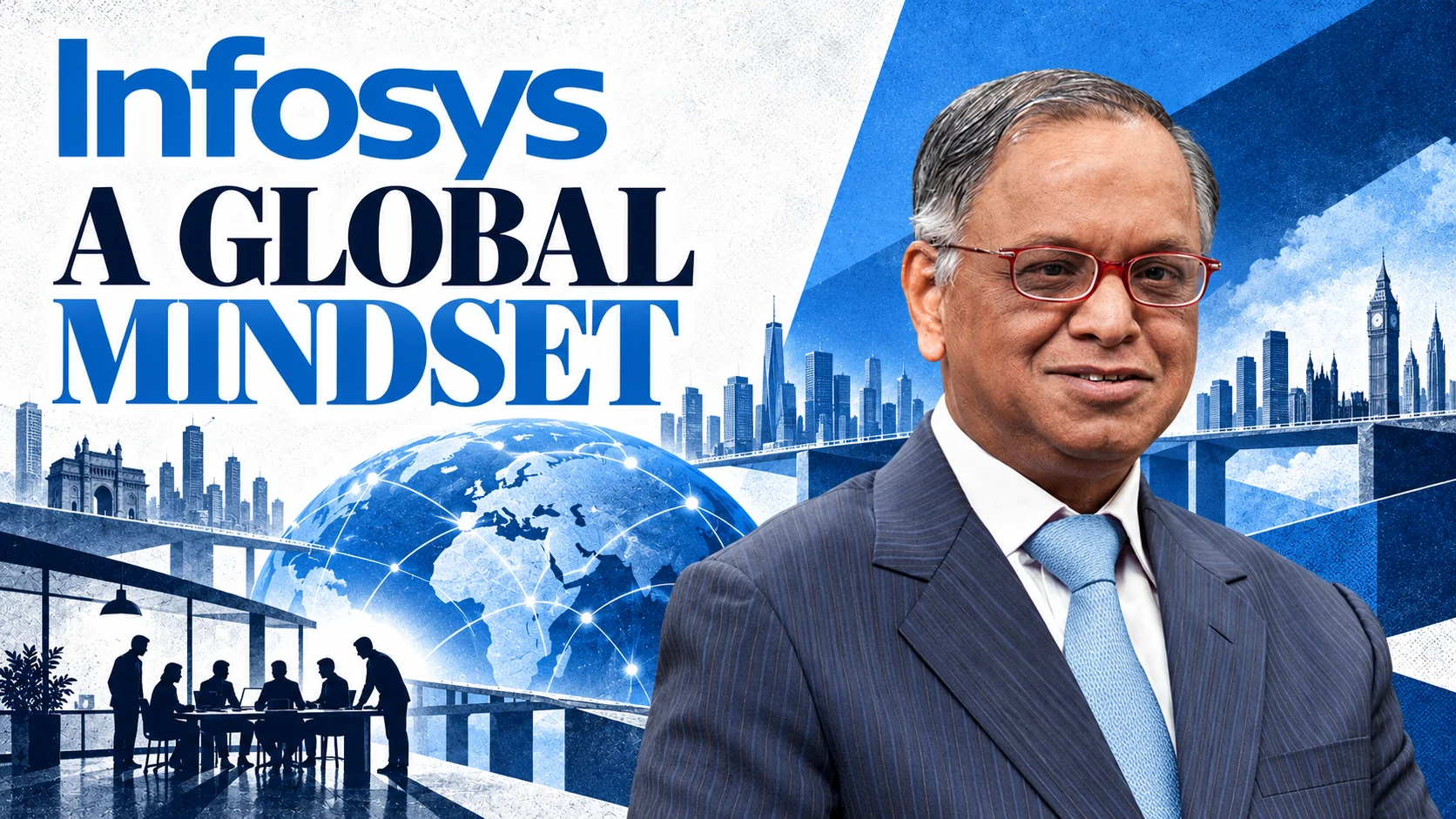
N. R. Narayana Murthy founded Infosys in 1981 with a team of fellow engineers. The company’s history is often told through the growth of Indian software services. Another way to read it is as a problem of organisation: how can people working across locations deliver work that a distant customer can trust?
Making distributed work coherent
Infosys credits Murthy with articulating its Global Delivery Model, based on collaboration across distributed software-development teams. The useful idea is not simply that work can move across borders. The handovers, responsibilities and quality expectations must also be clear enough for a project to remain coherent.
A service needs a repeatable method
An engineering team can complete one difficult assignment through exceptional effort. Building an enduring services business requires that knowledge to be shared and used again. Training, documentation, management and customer communication become part of the product, even though they do not appear as features on a screen.
The founder lens
Our interpretation is that an organisation can itself be an entrepreneurial invention. A founder is shaping how people make decisions and how the company learns from delivery. Murthy’s story invites a practical question for a young team: which parts of today’s success depend on a person’s memory, and which can become a dependable way of working?
Make the handover part of the work
A distributed team can appear efficient while important assumptions remain in one person’s head. The difficulty becomes visible when work changes hands: what is complete, what has been tested and what still needs a decision? A founder can improve that handover by defining the evidence another team needs to continue confidently. Documentation is only useful when it helps the recipient act. Too little creates ambiguity; too much can hide the essential point. Review a project from the customer’s perspective and identify where internal responsibilities become unclear externally. The operating lesson is to build a shared method of delivery that does not depend on one founder personally resolving every uncertainty.
Put the idea to work
Use these questions to investigate the idea in your own context.
- Define what a completed handover must contain.
- Ask the receiving team which assumptions are missing.
- Give the customer a clear owner for decisions that cross team boundaries.
A closer look
What does the Global Delivery Model add to the founder story?
It provides a way to examine how software work can be coordinated across distributed teams. This profile focuses on responsibilities and dependable delivery, rather than assuming that moving tasks between locations automatically creates a better service.
Sources & editorial note
This profile draws on the public sources below. Company and founder accounts describe their own perspective. Our analysis, questions and takeaway are editorial interpretation. This is not an original interview or a sponsored feature.
See our editorial standards or request a correction. For another perspective, read What an incubator brings to the table.