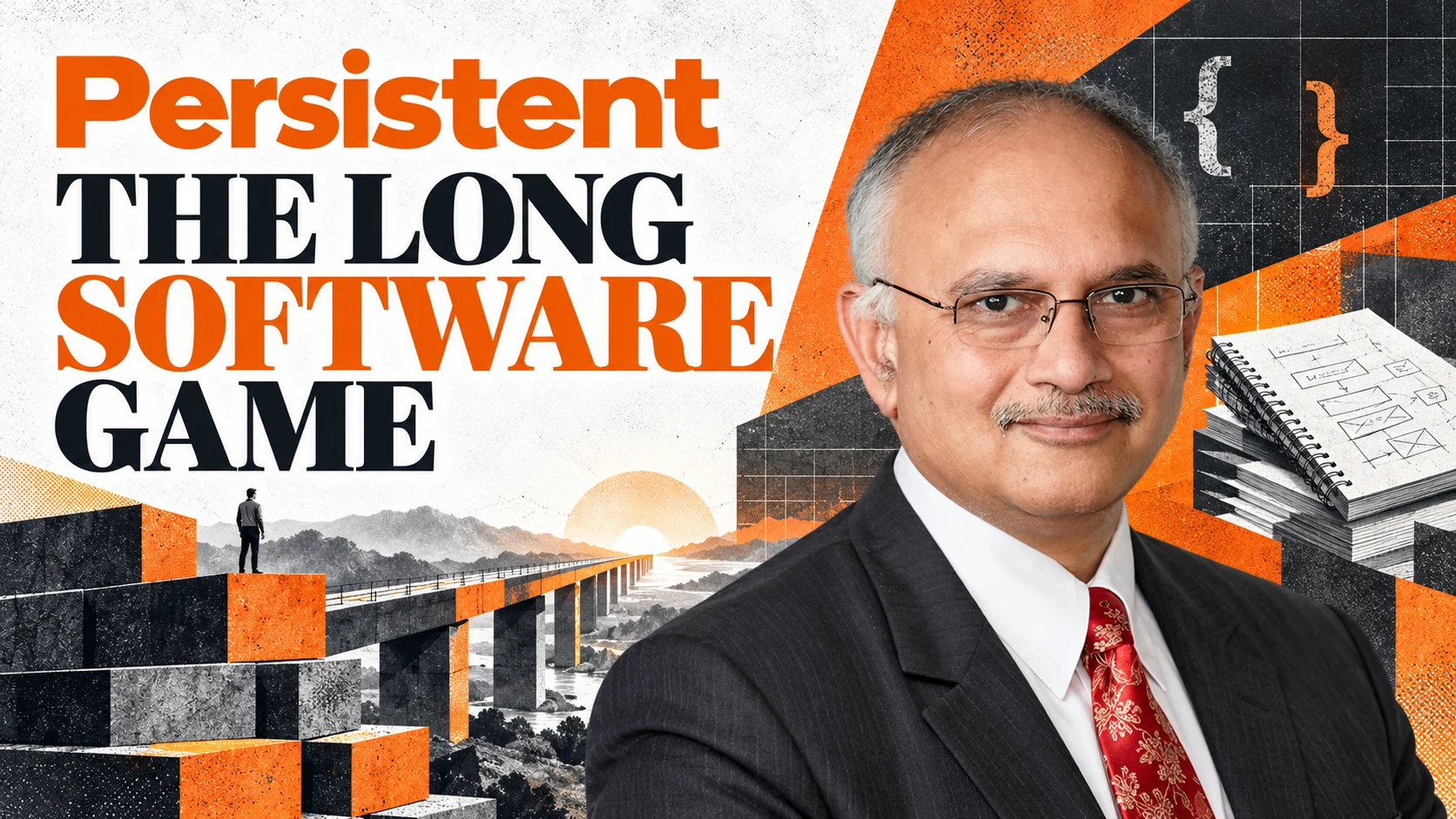
Who is Anand Deshpande?
Anand Deshpande founded Persistent Systems in 1990 after working at Hewlett-Packard Laboratories in California. The Pune-based beginning connects computer-science research with software engineering for customers. This profile explores the work of turning specialist expertise into an enduring delivery organisation.
- Founder profiled
- Anand Deshpande
- Company or institution
- Persistent
- Reading lens
- Technology services
Source starting point: Persistent Systems: Anand Deshpande’s biography ↗. Full sources and context appear below.
Anand Deshpande founded Persistent Systems in 1990 after working at Hewlett-Packard Laboratories in California. His background included computer-science research, and the company grew from a small Pune venture into a digital-engineering business. The founder story is closely tied to the cultivation of technical capability.
Engineering as the starting point
Persistent’s public biography describes Deshpande’s work across technology, research, education and institution building. This provides a useful lens on a services venture: the company must develop people who can understand difficult problems, work with changing technologies and contribute to customers’ products over time.
Depth needs renewal
Specialist knowledge is valuable partly because it takes time to develop. Yet software keeps changing, so depth cannot mean becoming fixed in one tool or platform. An engineering organisation needs ways to preserve useful experience while making room for new methods and different questions.
The founder lens
Our takeaway from this journey is to think of learning as an operating responsibility. A company that sells expertise must invest in how expertise is developed, shared and tested. For a founder, that raises a practical question: does the organisation become more capable after each project, or does the learning leave with the people who happened to do it?
Make technical learning an organisational habit
A services company can win work through a few exceptional individuals and still struggle to deliver consistently as it grows. The challenge is to turn individual expertise into ways of working that others can learn. Examine how a team reviews a difficult decision, explains unfamiliar technology and carries lessons into the next project. Training without an opportunity to apply the learning may not build much capability; delivery without time to reflect can repeat the same mistakes. For a founder, the practical question is how to balance customer commitments with the development of the people meeting them. Technical reputation depends on that daily relationship, not only the credentials of the original team.
The decision and its trade-offs
Technical knowledge becomes a business capability when someone else can depend on it. That requires recruiting, learning and delivery practices alongside engineering skill. For a founder coming from research, the transition includes defining the customer problem clearly enough that the quality of the work can be evaluated outside the laboratory or the founding team.
How to investigate the operating model
Look for the mechanisms that let knowledge move through the company: design reviews, documented decisions, mentoring and a way to learn from defects. The useful test is whether a new engineer can understand why a system works as it does and change it safely. Expanding the team without improving that transfer can increase coordination work faster than useful delivery capacity.
Evidence and context
A founder’s research background is relevant context, not proof of the quality of every project. Engineering-services work also differs from selling a standard software product; customer obligations and resource needs should be compared carefully.
Put the idea to work
Use these questions to investigate the idea in your own context.
- Choose a recent engineering decision and document its reasoning.
- Pair new learning with a real project responsibility.
- Review whether knowledge stays useful when a team member moves on.
A closer look
Why does technical depth matter beyond the founding team?
Customers depend on the organisation delivering the work, not only the founder understanding it. The Persistent profile uses an engineering-services setting to examine how learning, collaboration and repeatable delivery can become company capabilities.
What should a founder investigate in the Persistent story?
Review the quality of technical handovers, repeat customer work and the cost of rework. A larger team is not automatically a more capable one.
Sources & editorial note
This profile draws on the public sources below. Company and founder accounts describe their own perspective. Our analysis, questions and takeaway are editorial interpretation. This is not an original interview or a sponsored feature.
See our editorial standards or request a correction. For a useful comparison, read Sridhar Vembu: the Zoho founder story. Explore the founder topic guides for connected reading paths.