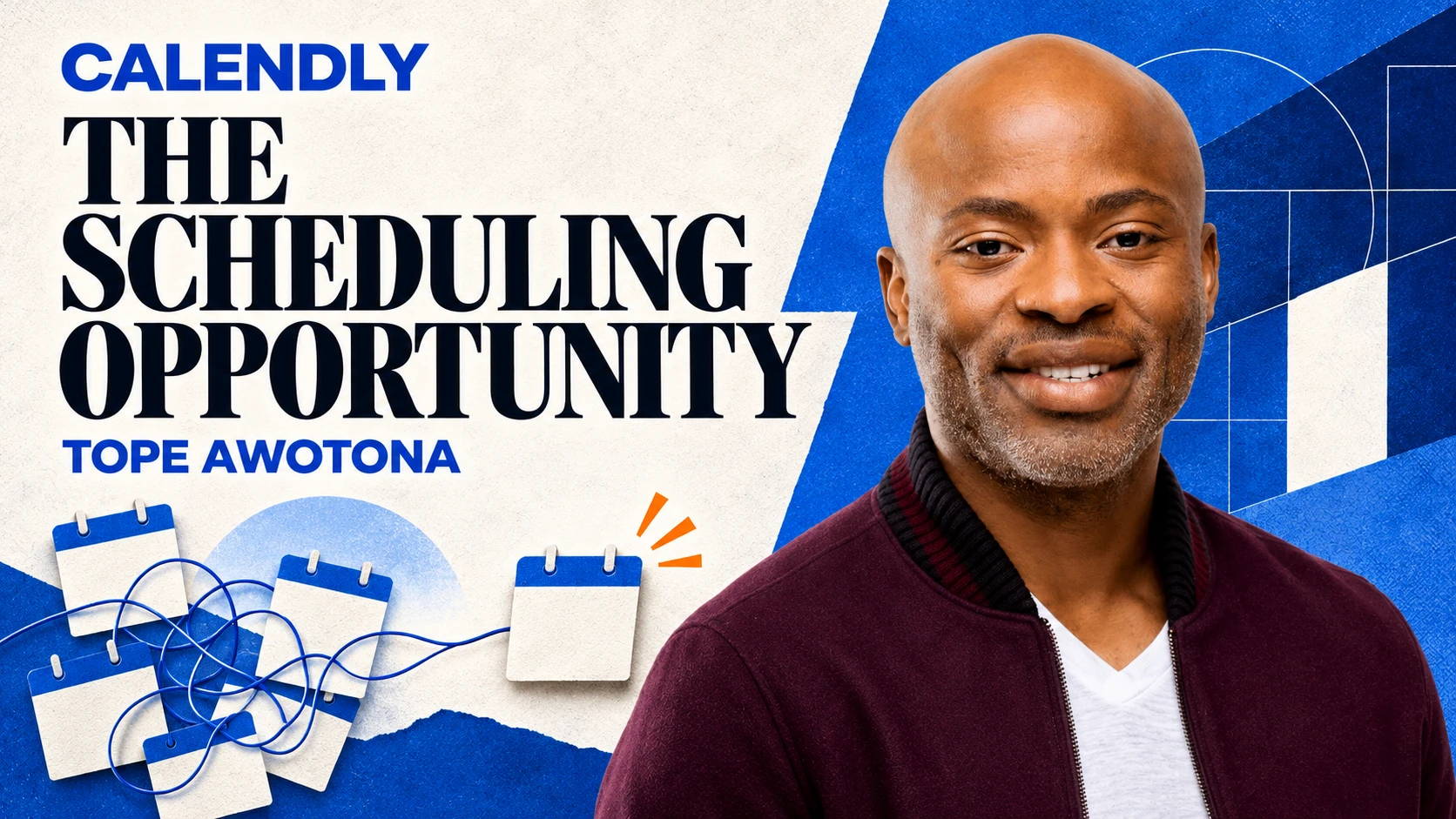
Who is Tope Awotona?
Tope Awotona founded Calendly in 2013 around the difficulty of arranging meetings. His public accounts describe research before development and a deliberate search for a better user experience. For founders, the useful question is how to turn personal frustration into a problem statement that other customers can recognise and act on.
- Founder profiled
- Tope Awotona
- Company or institution
- Calendly
- Reading lens
- SaaS & software
Source starting point: Calendly: About us and Tope Awotona’s official biography and portrait — checked 7 November 2026 ↗. Full sources and context appear below.
An ordinary task with a recurring cost
Calendly’s official biography identifies Tope Awotona as its founder and CEO and dates the company’s beginning to 2013. It describes a background in enterprise software sales and a goal of simplifying the exchanges required to arrange a meeting.
That starting point is useful precisely because it sounds modest. Scheduling sits between the intention to speak and the conversation itself. A founder investigating such a task should look beyond whether it is annoying: how often does it recur, who performs the work, and what happens when coordination stalls? Those questions turn a complaint into something that can be observed.
Research came before the product specification
In his 2018 interview with Atlanta Ventures, Awotona recalled trying scheduling tools while working in sales at EMC and finding them unsatisfactory. He described investigating the market before deciding to build, then translating his observations into detailed requirements. He also connected his experience demonstrating software with his understanding of usability.
Our reading is that familiarity with the task and familiarity with competing products served different purposes. The first helped him notice friction; the second helped define where an alternative might be useful. For another founder, disliking an existing tool is only the beginning. Ask users to show the last occasion on which the problem occurred, including the workaround they actually chose.
A founder’s conviction still needs a challenge
The University of Georgia’s account of Awotona’s April 2022 lecture records his recollection of spending six months studying the scheduling problem, competitors and customer reactions. It also records his warning about confirmation bias in his earlier businesses.
That is a valuable tension for a founder to keep visible. Research should sharpen a proposed solution, but it should also be capable of changing the decision to pursue it. Write down what would weaken your hypothesis before interviews begin. A complaint that occurs rarely, a workaround users prefer, or a purchase decision controlled by someone else may each change the scope of the opportunity.
This is Founderline’s suggested discipline, not a claim that one research method explains Calendly’s eventual results. A retrospective cannot show every decision, missed option or external condition that shaped a business.
The build required choices and collaborators
Awotona’s Atlanta Ventures interview describes seeking a technical cofounder and then working with a development partner. He recalled a planning session that included decisions about calendar integrations and the order of development. He dated the start of building to early 2013 and the product launch to September that year.
The practical lesson is to make dependencies explicit. A simple customer promise may require cooperation with tools the customer already uses. Before commissioning a build, specify the first complete action, the systems it depends on and the failure cases the team must handle. A feature list alone does not tell a developer which end-to-end result matters most.
Study the handoff, not just the person who pays
A scheduling interaction involves both the organiser and the person being invited. As an editorial lens, this makes Calendly a useful example for founders building products that cross organisational boundaries. One person may choose a tool while someone else must use the resulting invitation, request or document.
Test both sides of that handoff. Can the recipient understand what is being asked? Is the next action clear? Does the interaction create extra work for someone who did not choose the software? These questions also apply to proposals, payment requests and client onboarding. They are practical design questions, not evidence that every shared link will create organic growth.
Read the beginning separately from the current business
Calendly’s company page now describes a broader meeting-management offering, including scheduling, payments, notes, follow-ups and contacts. That current description should not be projected backwards onto the initial product. The useful comparison is between a focused starting task and the wider set of adjacent work the company now describes.
For an early founder, expansion is a decision to justify. Which next task becomes easier because the first one is already handled? Which requires a different buyer, capability or support model? A coherent sequence of customer needs is more informative than a long roadmap. Awotona’s early story gives readers a starting question: what recurring piece of work do you understand well enough to investigate deeply?
Investigate one recurring coordination problem
Use these questions to investigate the idea in your own context.
- Choose one task you have repeated this week and document the last occurrence.
- Observe how three potential users complete it with their current tools.
- Record a finding that supports your idea and one that challenges it.
- Define the first complete outcome and the external systems it depends on.
- Test the experience of both the initiating user and the recipient before adding more features.
A closer look
When was Calendly founded?
Calendly’s official company page dates its founding to 2013. In a 2018 interview, Awotona placed the product launch in September 2013. These are historical dates, not a November 2026 launch.
Is this a new interview with Tope Awotona?
No. It is an independently written retrospective using the linked public sources. The practical exercises and interpretations are Founderline’s own.
Does personal frustration establish demand?
It can reveal a task worth investigating. Founders still need to understand how frequently others encounter it, what alternatives they use and whether they will adopt a different approach.
Sources & editorial note
Independent retrospective researched on 7 November 2026. The 2013 founding and launch are historical milestones, not new announcements. Sources include Awotona’s 31 May 2018 Atlanta Ventures interview, the University of Georgia’s 13 April 2022 account of his campus lecture, and Calendly’s current company page. Founderline’s practical interpretations are editorial analysis, not statements by Awotona. No original interview or sponsorship is implied.
- Calendly: About us and Tope Awotona’s official biography and portrait — checked 7 November 2026
- Atlanta Ventures: Tope Awotona, founder interview — 31 May 2018
- University of Georgia, Terry College of Business: Calendly founder learned to persevere through trial and error — 13 April 2022
See our editorial standards or request a correction. For a useful comparison, read Ritesh Arora and Nakul Aggarwal: the testing problem behind BrowserStack. Explore the founder topic guides for connected reading paths.