Who is Tarun Mehta?
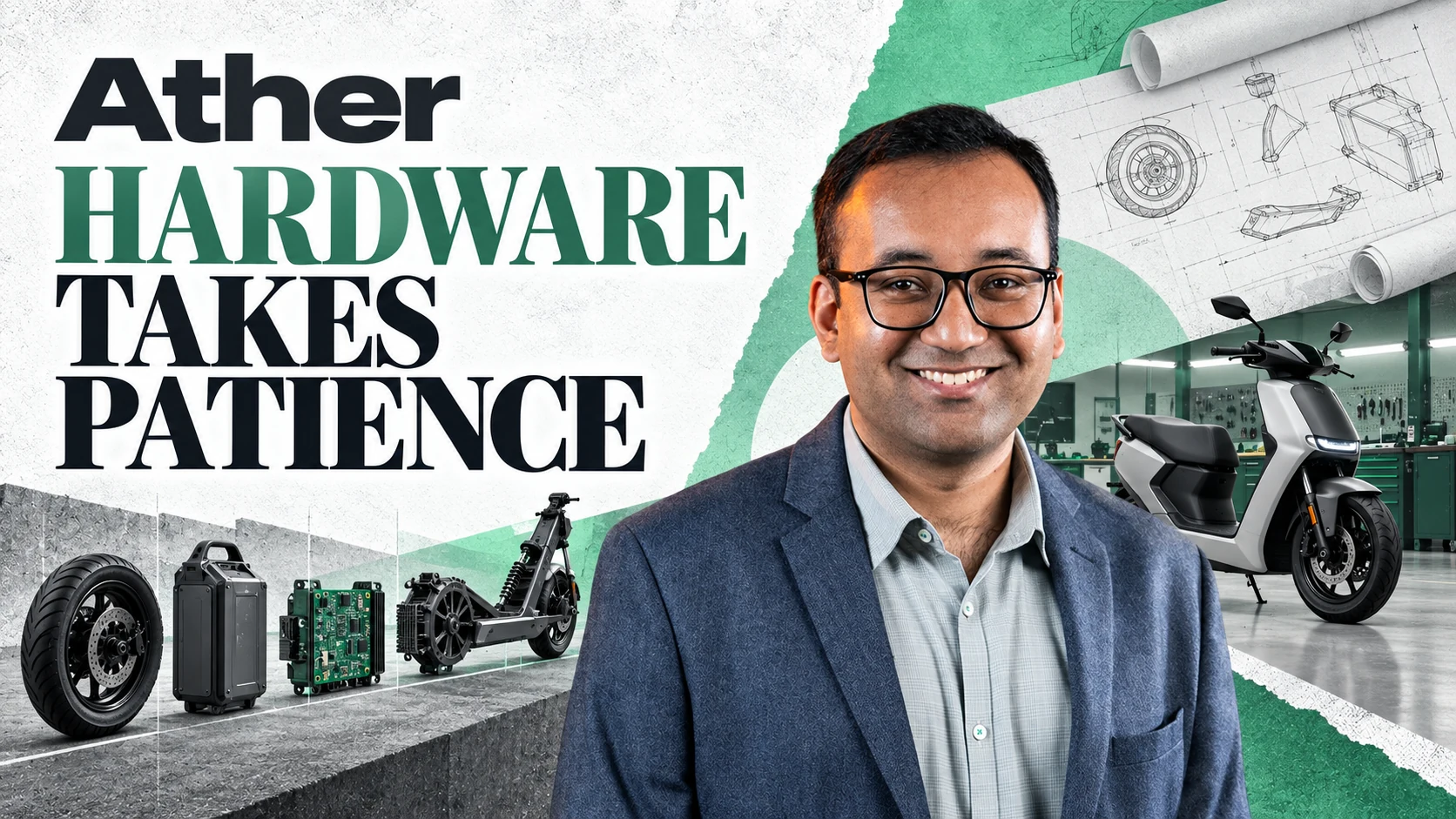
Tarun Mehta cofounded Ather Energy with Swapnil Jain. The company’s early development brought together electric-vehicle hardware, software and manufacturing. The story highlights the distance between a working engineering idea and a product that customers can use and maintain in ordinary conditions.
- Founder profiled
- Tarun Mehta
- Company or institution
- Ather Energy
- Reading lens
- Mobility & hardware
Source starting point: Ather Energy: company journey and engineering leadership ↗. Full sources and context appear below.
An electric scooter is a physical product with a software layer, a manufacturing process and a service life. Ather’s founder story, associated with Tarun Mehta and Swapnil Jain, brings these pieces together. The company’s published journey traces its early work through the 2013–2018 period, before its later expansion.
The disciplines have to meet
Ather’s leadership description places hardware, software, electronics and mechanical engineering within the same product effort. It also identifies manufacturing, supplier management, after-sales work and charging infrastructure as distinct responsibilities. The customer encounters the result as one vehicle, even though the organisation must coordinate many kinds of expertise.
The prototype is a beginning
A working demonstration can establish that an idea is possible. A customer product needs repeatable production, comprehensible maintenance and a practical response when something fails. Those demands change the schedule and the team a hardware founder needs. Progress cannot be understood entirely through software-style release frequency.
The founder lens
Our interpretation of Mehta’s venture is to identify the complete system required to support the object being sold. The engineering brief should include the product’s life after delivery. A company that recognises that early can make more realistic choices about milestones, partnerships and the capabilities it needs to develop.
Trace the feedback from use back into engineering
A vehicle leaves the development team and enters a much wider range of conditions. A founder should ask how the organisation learns from those conditions and distinguishes a design issue from a service or communication issue. Manufacturing consistency, supplier decisions and after-sales knowledge each affect the experience. Improving one area can change requirements elsewhere, making cross-team understanding essential. The useful reading of a hardware journey is therefore not only the time taken to launch. It is the work of building a feedback loop that can support the product through use. A strong demonstration is a milestone within that larger responsibility, not the completion of it.
The decision and its trade-offs
An electric vehicle combines interdependent systems. A change that improves one component can affect cost, durability, manufacturability or service elsewhere. The founder’s challenge is to learn across those interfaces while deciding which parts of the experience the organisation must develop directly and which depend on suppliers or partners.
How to investigate the operating model
Map the product beyond the first demonstration: assembly, delivery, charging, maintenance and fault diagnosis. For each stage, identify the evidence required before promising reliability to customers. Field use can reveal constraints that a controlled test misses. A development plan should connect engineering milestones to the support capabilities needed when the product leaves the team’s hands.
Evidence and context
A founder history does not establish the safety, range or performance of a current vehicle model. Hardware development also involves time and capital requirements that differ from those of a purely digital service.
Put the idea to work
Use these questions to investigate the idea in your own context.
- Map which teams influence a customer issue after delivery.
- Identify how field feedback reaches the people designing the next revision.
- Include serviceability when describing the product promise.
A closer look
Why does a vehicle startup need more than a strong prototype?
Customers need a product that can be produced, used and supported consistently. The Ather profile examines those organisational requirements without reviewing current vehicle specifications, safety performance or purchase suitability.
What should a founder investigate in the Ather Energy story?
Compare prototype behaviour with repeated production, field reliability and service readiness. Those are separate stages of evidence.
Sources & editorial note
This profile draws on the public sources below. Company and founder accounts describe their own perspective. Our analysis, questions and takeaway are editorial interpretation. This is not an original interview or a sponsored feature.
- Ather Energy: company journey and engineering leadership
- Ather Energy: founding leadership and governance
See our editorial standards or request a correction. For a useful comparison, read Shiv Nadar: the HCL founder story. Explore the founder topic guides for connected reading paths.