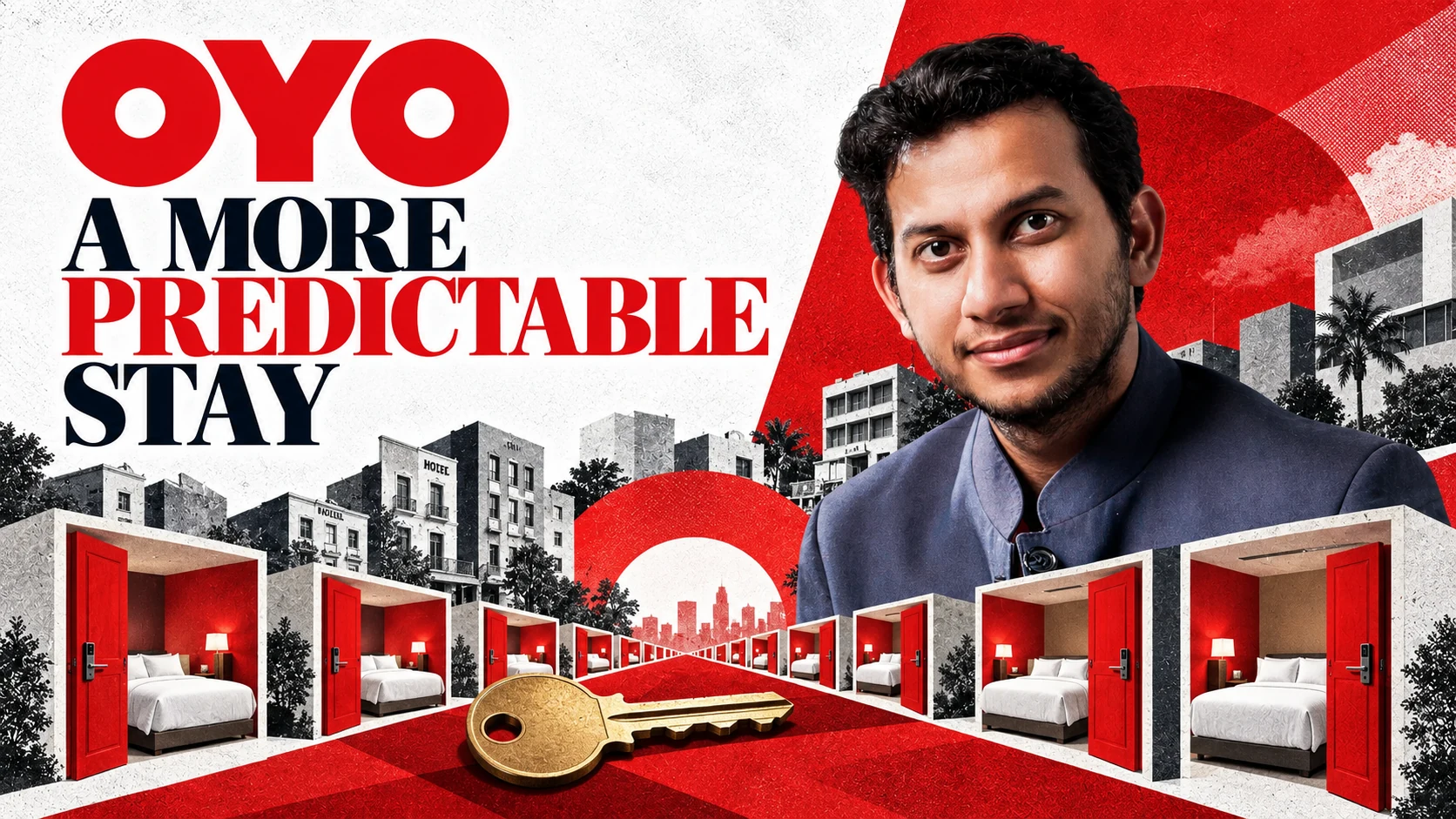
Who is Ritesh Agarwal?
Ritesh Agarwal founded OYO. The company links its origins to his experience travelling in India and finding inconsistent affordable accommodation. This story examines the challenge of delivering a recognisable hospitality promise across individual properties and local operators.
- Founder profiled
- Ritesh Agarwal
- Company or institution
- OYO
- Reading lens
- Travel
Source starting point: OYO: company timeline and Ritesh Agarwal’s founding story ↗. Full sources and context appear below.
Booking a room means buying an experience before seeing it. For a traveller, uncertainty can sit between the listing and the stay. OYO’s account of its origins links Ritesh Agarwal’s travels in India with the difficulty of finding consistent, affordable accommodation in the unbranded hotel category.
A brand across separate properties
The company dates the beginning of OYO’s journey to 2013. Its timeline records the consumer website, a later mobile app and OYO OS, introduced for property managers in 2018. These milestones show that the business involved tools for accommodation providers as well as a way for guests to discover rooms.
Consistency is operational
A shared brand can make a promise visible, but it cannot fulfil the promise by itself. Cleanliness, check-in, maintenance and the handling of a complaint take place at a property. The interesting entrepreneurial challenge is how a platform supports and checks an experience delivered by many separate operators.
The founder lens
Our takeaway from this journey is to examine the gap between the expectation a brand creates and the system that must deliver it. Standardisation is useful only when people can carry it out in real conditions. For a hospitality venture, the stay remains the product, even when the booking begins on a phone.
A standard must survive the handover
A booking page can describe a room precisely, yet the guest’s experience is shaped later by check-in, cleanliness, maintenance and how a concern is resolved. For a founder building across partner locations, the important question is how expectations travel from the central product to the person delivering the service. A checklist is useful only if somebody can observe the condition, act on a gap and verify that it has been addressed. A growing network can offer more choice while also creating more variation. Study complaints by property and by stage of the stay to understand where a general promise needs a more specific operating response.
The decision and its trade-offs
A guest chooses a room before experiencing it. The founder opportunity lies in reducing the uncertainty between what is described and what is delivered. A shared brand can make a promise visible, but local cleaning, maintenance, check-in and problem-solving determine whether that promise survives. Standardisation therefore needs an operating process, not only a common visual identity.
How to investigate the operating model
Follow a booking from listing to departure and assign responsibility at each stage. Ask who detects a room-quality problem before arrival, who can authorise a remedy and how a recurring issue reaches the team that sets standards. Reviews and complaints should be grouped by property and by type of failure; an overall score can hide a repeated local problem.
Evidence and context
A network’s size does not establish uniform guest experience. Property arrangements and service conditions can change, so this profile is not a current evaluation of a hotel or booking offer.
Put the idea to work
Use these questions to investigate the idea in your own context.
- Write the guest promise in terms a local operator can verify.
- Identify who handles a mismatch between the listing and the room.
- Review the entire stay, including check-in and problem resolution.
A closer look
What does predictability mean in a hospitality startup?
It means that the customer can understand what to expect and has a clear route when reality differs. This profile uses hospitality to examine that operating challenge; it does not guarantee the quality of any particular property or booking.
What should a founder investigate in the OYO story?
Compare the promised room attributes with observed conditions and complaint resolution. The relevant unit of analysis may be a property or a stay, not the brand as a whole.
Sources & editorial note
This profile draws on the public sources below. Company and founder accounts describe their own perspective. Our analysis, questions and takeaway are editorial interpretation. This is not an original interview or a sponsored feature.
See our editorial standards or request a correction. For a useful comparison, read Deep Kalra: the MakeMyTrip founder story. Explore the founder topic guides for connected reading paths.