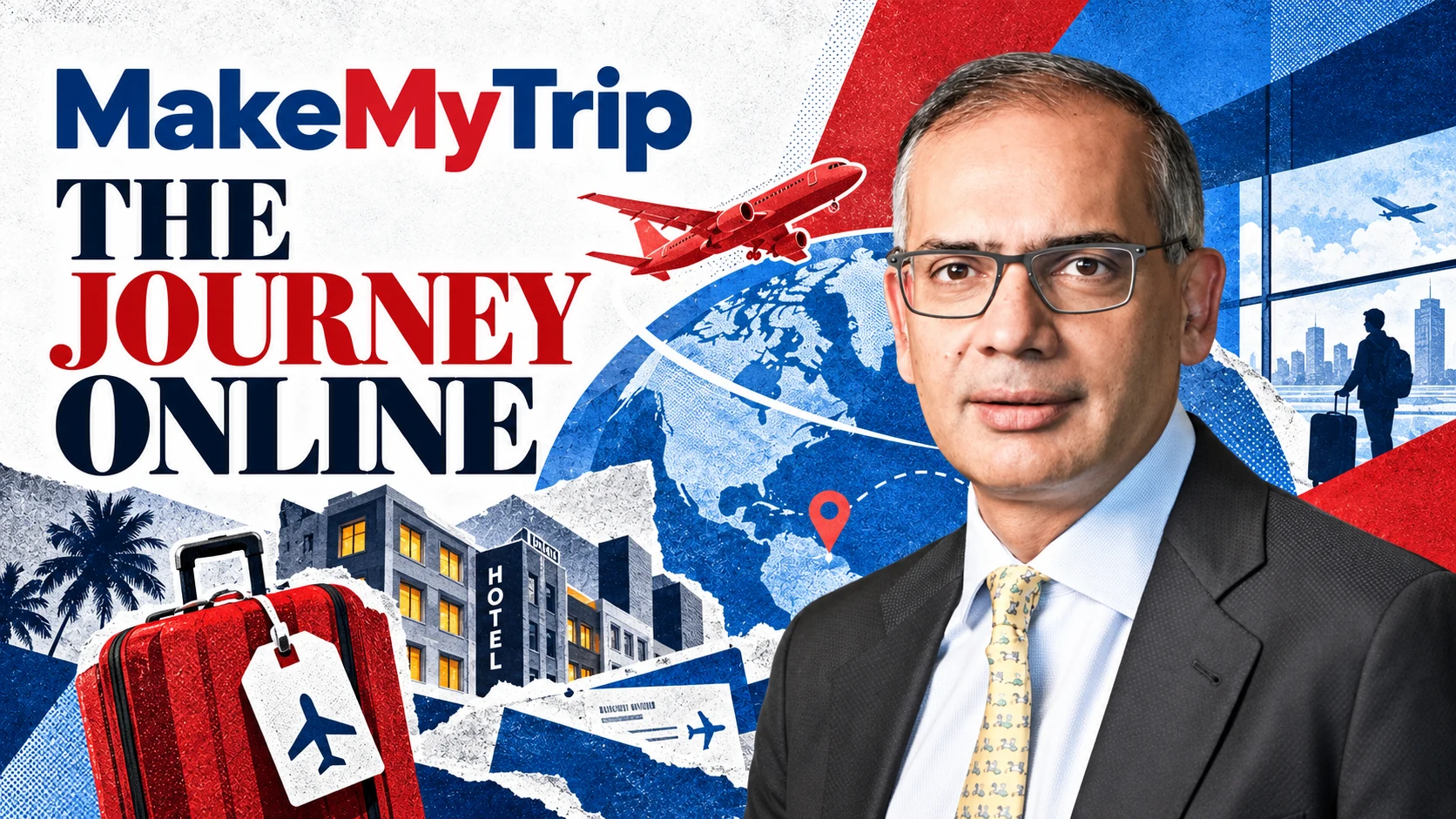
Who is Deep Kalra?
Deep Kalra founded MakeMyTrip. It began operations in 2000 with a focus on Indians in the United States travelling between the two countries. Its early journey illustrates how a narrowly defined first customer can guide a business in a very large category.
- Founder profiled
- Deep Kalra
- Company or institution
- MakeMyTrip
- Reading lens
- Travel
Source starting point: MakeMyTrip: company history, business model and leadership ↗. Full sources and context appear below.
Travel is a large category, but a new company still needs a clear first customer. MakeMyTrip began operations in 2000 by serving Indians in the United States, with a focus on travel between the two countries. Founder Deep Kalra’s journey can be read through that deliberately specific starting point.
A sequence of markets
The company’s history records the launch of its India website in September 2005. Its platform subsequently brought together flights, accommodation and other travel services. The sequence matters because access to a market is also access to a set of habits: how people compare, book, pay and ask for assistance.
The purchase is part of a longer trip
A travel booking is rarely the end of the customer’s need. Plans can change, suppliers can alter a service and several reservations may have to work together. A marketplace must therefore think about the traveller’s entire journey, even when different providers deliver its individual parts.
The founder lens
Our interpretation is that starting narrowly can make a complicated category understandable. A particular route or customer group creates a setting in which to learn before expanding. The lesson is not to copy the same sequence, but to identify which part of a large market gives a new team the clearest view of a recurring problem.
Choose a corridor you can understand deeply
A focused travel audience has particular questions about schedules, payment, documentation and what happens when plans change. Understanding those questions can be more useful than launching a broad catalogue with little service depth. A founder studying this case should trace the journey after purchase as carefully as the booking itself. A confirmation email is not the end of the customer’s need. Changes, cancellations and coordination with suppliers may reveal where the business actually earns trust. As the audience expands, the company needs to learn which assumptions still hold and which were specific to its original market. A clear starting segment is a learning choice, not a permanent limit on ambition.
The decision and its trade-offs
A specific starting audience makes an otherwise broad market easier to investigate. Instead of asking how everyone books travel, the team can understand a particular route, set of questions and purchase context. Founders can use that focus to identify which information and service gaps matter most before expanding to customer groups with different expectations.
How to investigate the operating model
A booking is a promise involving suppliers and future events. Study the workflow after payment: itinerary changes, cancellation questions and disruptions. The customer may experience the platform as the owner of the problem even when another organisation controls the service. Clear responsibility and timely information are therefore part of the product, not an optional support layer.
Evidence and context
A successful initial segment is not necessarily the largest eventual audience. Historical customer focus should not be mistaken for the company’s current scope or a claim about present travel conditions.
Put the idea to work
Use these questions to investigate the idea in your own context.
- Describe one travel segment and its most frequent uncertainties.
- Map the responsibilities of the platform and each supplier.
- Test how clearly the customer can understand a changed itinerary.
A closer look
Why is MakeMyTrip’s early customer corridor useful to study?
It makes the initial problem concrete. A particular group of travellers gives a team a setting in which to learn about booking, payment and service needs before extending the same proposition to a wider audience.
What should a founder investigate in the MakeMyTrip story?
Look at successful trip completion and the handling of changes alongside bookings. A transaction total cannot show whether the customer understood what they purchased.
Sources & editorial note
This profile draws on the public sources below. Company and founder accounts describe their own perspective. Our analysis, questions and takeaway are editorial interpretation. This is not an original interview or a sponsored feature.
See our editorial standards or request a correction. For a useful comparison, read Ritesh Agarwal: the OYO founder story. Explore the founder topic guides for connected reading paths.