The story in brief
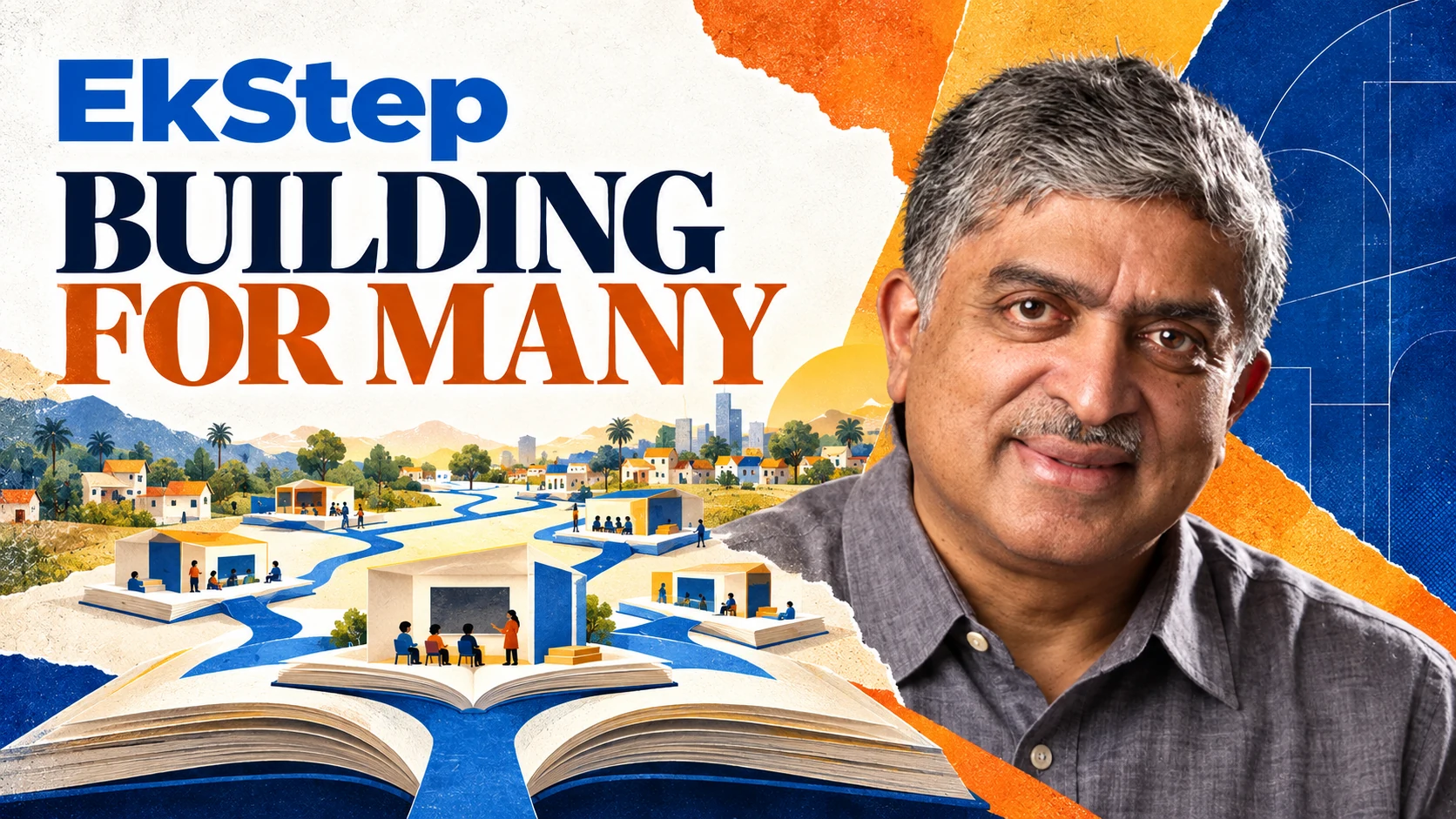
EkStep presents a founder story about enabling other builders. Shared technology becomes useful through the institutions, communities and local adaptations around it.
A venture can be designed to help other people build. EkStep names Nandan Nilekani, Rohini Nilekani and Shankar Maruwada as its cofounders. The foundation describes its work through connections among society, markets and governance, with technology serving a broader ambition for participation and progress.
A wider unit of design
When many organisations must contribute to an outcome, the product is only part of the problem. People need ways to work together, adapt ideas to their own setting and carry knowledge between institutions. EkStep’s stated approach invites attention to those relationships rather than treating technology as a complete intervention by itself.
Reuse requires room for difference
Something built for many users or organisations must accommodate variation without becoming impossible to understand. Shared components can reduce duplicated work, while local participants bring knowledge of the people they serve. Finding that balance is an organisational challenge as much as a technical one.
The founder lens
Our interpretation of this chapter in Nilekani’s work is to ask what becomes possible when another team can build on what yours has created. That question changes the measure of success. The useful outcome may include capabilities and connections beyond the founding organisation, even when their contribution is harder to capture in a single company metric.
Design for participation beyond the original team
A tool intended for many organisations has to make sense outside the setting in which it was created. Documentation, understandable responsibilities and room for adaptation become part of the proposition. A founder can study participation by following a new organisation’s first attempt to use the work. Which assumptions are unexplained? Where is permission or assistance required? Shared infrastructure can reduce duplicated effort, but it does not remove the need for local knowledge or a sustainable operating arrangement. The useful question is what others can accomplish independently because the foundation exists. That keeps the story grounded in actual capability rather than treating a platform announcement as an outcome in itself.
Put the idea to work
Use these questions to investigate the idea in your own context.
- Describe the task another organisation should be able to complete.
- Test the first-use journey without assistance from the original team.
- Identify what must remain common and what can adapt locally.
A closer look
How does enabling other builders differ from selling one product?
The intended outcome depends partly on what other organisations do with the shared work. The founder therefore needs to consider adoption, documentation and institutional relationships alongside the technology itself. EkStep provides a setting for examining those choices.
Sources & editorial note
This profile draws on the public sources below. Company and founder accounts describe their own perspective. Our analysis, questions and takeaway are editorial interpretation. This is not an original interview or a sponsored feature.
See our editorial standards or request a correction. For another perspective, read What an incubator brings to the table.