Who is James Dyson?
James Dyson’s public accounts connect a household frustration with repeated physical experimentation. They also contain a different decision: ending an automotive project that the company said it could not make commercially viable. Together, these episodes give founders a useful question: what must the next test establish?
- Founder profiled
- James Dyson
- Company or institution
- Dyson
- Reading lens
- Consumer brands
Source starting point: Dyson: Sir James Dyson biography and official photograph — checked 19 November 2026 ↗. Full sources and context appear below.
Begin with the failure you can observe
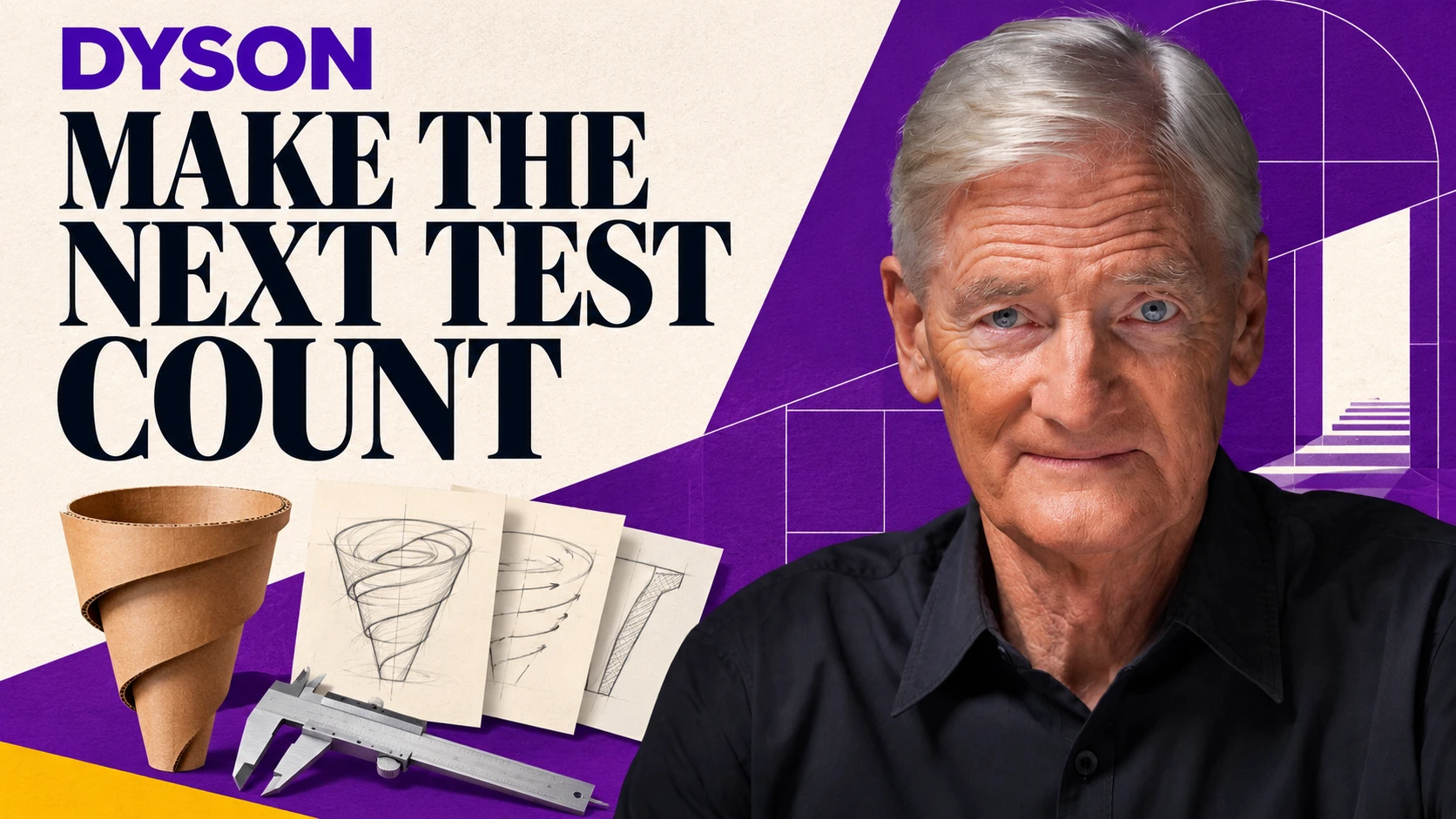
Dyson’s official biography describes James Dyson encountering clogging filters in industrial work and a similar problem with a household vacuum cleaner. He tried a cardboard cyclone in place of the vacuum’s bag. The biography records 5,127 prototypes in the development story and dates the DC01 launch to 1993.
The useful starting point is the observable failure. A product is supposed to perform a task, but something in ordinary use prevents it from doing that reliably. Describing the failure precisely gives a founder a better experiment than beginning with a broad promise to reinvent a category.
Write down when the problem happens, what changes as it develops and how the user responds. A complaint about performance might involve the core mechanism, maintenance, setup or a misunderstood control. Those are different problems, even when the customer describes them with the same frustrated sentence.
Treat the prototype count as history
The number of prototypes in Dyson’s account is memorable. It should not become a target for another founder or a prediction that enough attempts will produce the same outcome. The public biography does not provide a test log from which a reader could reconstruct every iteration.
Our suggested discipline is to name the uncertainty before making the next version. State what will change, what will stay comparable and what observation would matter. If several things change at once, record that limitation rather than attributing the result to whichever change the team likes most.
A rough prototype can be appropriate when it isolates one question. It becomes less useful when its roughness introduces so many other problems that the result cannot be interpreted. The aim is evidence that informs a decision, rather than a growing collection of objects that mainly demonstrates effort.
Keep technical and commercial questions separate
In his official update dated 10 October 2019, James Dyson said the automotive team had developed a car but could not make it commercially viable. He announced the board’s decision to propose closing the project and described efforts to find alternative roles for affected staff.
That statement belongs to 2019. It is not a new withdrawal announcement, and it does not establish which decision another hardware company should make today. It does show why a founder story should include more than the projects that reached customers.
For a small team, technical progress and commercial readiness deserve separate reviews. A mechanism may work while the costs, production process or customer proposition remain unresolved. Passing one test should not silently count as passing all of them. Decide which question the available evidence actually answers.
Define the next test before celebrating the last one
Imagine a fictional team building a reusable dispenser. Its latest prototype releases the intended quantity under controlled conditions. That result may justify investigating repeated use, cleaning or manufacturing consistency; it does not establish that a buyer will adopt the product.
List the remaining uncertainties by the decision they block. Some require a physical test, some require observing a user, and others require a supplier discussion or a cost estimate. Do not keep refining the easiest test while leaving the most consequential uncertainty untouched.
Choose a bounded next step with an owner and an expected observation. Keep the result together with the conditions under which it was obtained. A video of a successful demonstration is more informative when the team can explain how often it was attempted and where it still fails. This example and workflow are illustrative, not claims about Dyson.
Make stopping a considered decision
Persistence can be useful when a test reveals a specific obstacle and the team has a credible way to investigate it. Repeating work without changing the explanation or the experiment provides a weaker reason to continue.
Before another development cycle, agree what evidence would justify proceeding, revising the approach or pausing it. Include the resources required to reach that evidence. A decision made this way can be reviewed against the information available at the time, instead of being judged only through a later success story.
Dyson’s automotive statement offers an important counterweight to a simplistic persistence narrative. Our interpretation is not that stopping is inherently wiser than continuing. It is that a founder needs room to assess the project’s prospects without treating past effort as proof that another cycle will resolve the problem.
Preserve what the work taught the team
A prototype record should help someone else understand the next decision. Keep the problem description, configuration, test conditions, observations and unresolved questions in one place. Preserve unsuccessful results alongside the attractive demonstration.
If a project changes direction, distinguish reusable knowledge from assumptions that depended on the old context. A component that worked in one environment may need fresh testing in another. Learning survives a pause only when the team can explain what it actually established.
Read James Dyson’s story as an invitation to make experimentation more deliberate. The next version should earn its place by answering a question. The founder’s job is to connect that answer to a customer problem and a realistic decision about the work that follows.
Write the brief for your next prototype
Use these questions to investigate the idea in your own context.
- Describe one failure observed during the intended task.
- Name the uncertainty the next version will test.
- Record what changes and what stays comparable.
- Define the evidence needed to continue, revise or pause.
- Keep the result and remaining questions with the prototype record.
A closer look
Is this a new Dyson product announcement?
No. This retrospective was published on 19 November 2026 and uses explicitly dated historical events and current access to official source material.
Should a founder aim to build thousands of prototypes?
No. The historical count is not a recommended target. Founderline’s suggested approach is to judge each test by the uncertainty it resolves and the decision it supports.
Does a working prototype prove commercial viability?
No. A working mechanism answers a technical question. Production, costs, customer adoption and other operating requirements need their own evidence.
Sources & editorial note
Independent retrospective researched on 19 November 2026 from Dyson’s official biography and James Dyson’s automotive update dated 10 October 2019. The DC01 launch in 1993 and the automotive decision in 2019 are historical events, not new announcements. The testing framework below is Founderline analysis, not a reconstruction of Dyson’s internal development process. No original interview or sponsorship is implied.
- Dyson: Sir James Dyson biography and official photograph — checked 19 November 2026
- James Dyson: Dyson Automotive update — 10 October 2019
See our editorial standards or request a correction. For a useful comparison, read Tobi Lütke’s Shopify: when the tool becomes the business. Explore the founder topic guides for connected reading paths.