Who is Deepinder Goyal?
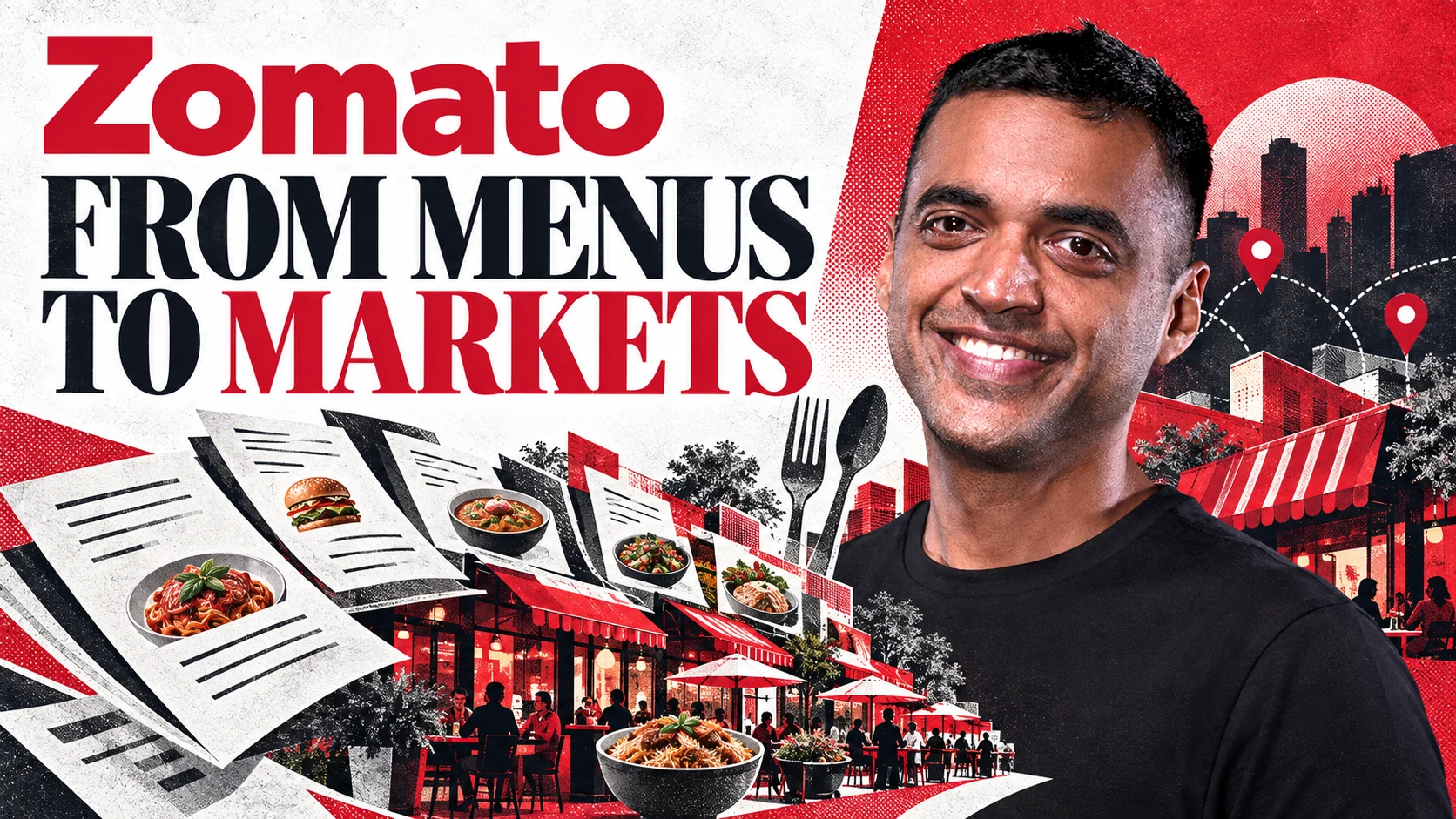
Deepinder Goyal is a cofounder of Zomato, whose origins date to 2008 as a restaurant search and discovery service. The later food-delivery business added physical fulfilment to an information product. This profile examines what changes when a platform starts delivering the outcome it helps people choose.
- Founder profiled
- Deepinder Goyal
- Company or institution
- Zomato
- Reading lens
- Food & delivery
Source starting point: Eternal: Zomato’s origins and business ↗. Full sources and context appear below.
Finding a restaurant and getting a meal are related needs, but they are different businesses to build. Zomato began in 2008 as a restaurant search and discovery platform. Its later delivery business added a new promise: coordinating the journey from a restaurant’s kitchen to a customer’s door.
The information layer
Deepinder Goyal, who worked at Bain before founding Zomato, helped build a product around making food choices easier. The company’s own history describes its progression from discovery to an ecosystem connecting consumers, restaurants and delivery partners. The useful starting point was a repeated decision in everyday life.
More participants, more responsibilities
A discovery product can organise information. A delivery marketplace must also deal with preparation, availability, movement and support. Each participant sees a different part of the same order. For a founder, expanding across these layers changes the work: product design becomes inseparable from the incentives and reliability of the network.
What the journey invites us to ask
Our editorial question is where a company’s original insight remains useful as its responsibilities grow. Does a new service remove a customer difficulty the team already understands? Can the operating model support the expectation the interface creates? Zomato’s history makes those questions more interesting than treating expansion as an automatic sign of progress.
Expansion changes what the company must know
A restaurant listing can be useful even when a customer never orders through the platform. Delivery requires additional information to remain accurate at the moment it is needed: whether an item is available, when preparation is complete and how a handover will happen. For a founder considering an adjacent service, map the new responsibilities before estimating the new audience. Some capabilities transfer; others have to be built. A familiar brand or a large discovery audience does not remove this work. The important operating question is whether the new service can keep its promise when one participant is late, unavailable or confused about the next step.
The decision and its trade-offs
Discovery and delivery serve related intentions but require different commitments. A restaurant listing helps someone decide; delivery coordinates availability, preparation, pickup and arrival. Founders considering an adjacent service should identify which existing assets transfer, such as audience or restaurant information, and which capabilities must be built afresh. Shared customers do not mean identical operating economics.
How to investigate the operating model
Write down the information each participant needs at each handover. A customer wants a credible arrival estimate, a restaurant needs an accurate order and a delivery partner needs an actionable pickup. Trace what happens when one of those facts changes. The recovery process often reveals more about a marketplace’s maturity than the ideal journey shown in an app demonstration.
Evidence and context
An origin story does not establish current leadership, market share or profitability. Restaurant discovery, food delivery and other businesses associated with the corporate group should not be treated as a single unchanged model.
Put the idea to work
Use these questions to investigate the idea in your own context.
- Separate the information problem from the fulfilment problem.
- List the new responsibilities created by your proposed expansion.
- Design a clear update and recovery path for an interrupted order.
A closer look
What can a marketplace founder learn from Zomato’s origins?
Start with the recurring decision a customer needs help making. Then examine how the business changes if it begins fulfilling that decision. Discovery, ordering and delivery can share an audience while requiring different systems, relationships and measures of reliability.
What should a founder investigate in the Zomato story?
Separate discovery engagement from completed orders, fulfilment failures and repeat ordering. Each describes a different part of the customer journey.
Sources & editorial note
This profile draws on the public sources below. Company and founder accounts describe their own perspective. Our analysis, questions and takeaway are editorial interpretation. This is not an original interview or a sponsored feature.
See our editorial standards or request a correction. For a useful comparison, read Sriharsha Majety: the Swiggy founder story. Explore the founder topic guides for connected reading paths.