The story in brief
Ola’s ride marketplace connects software with a physical service. Matching, pickup, communication and support all affect whether a booking becomes a successful journey.
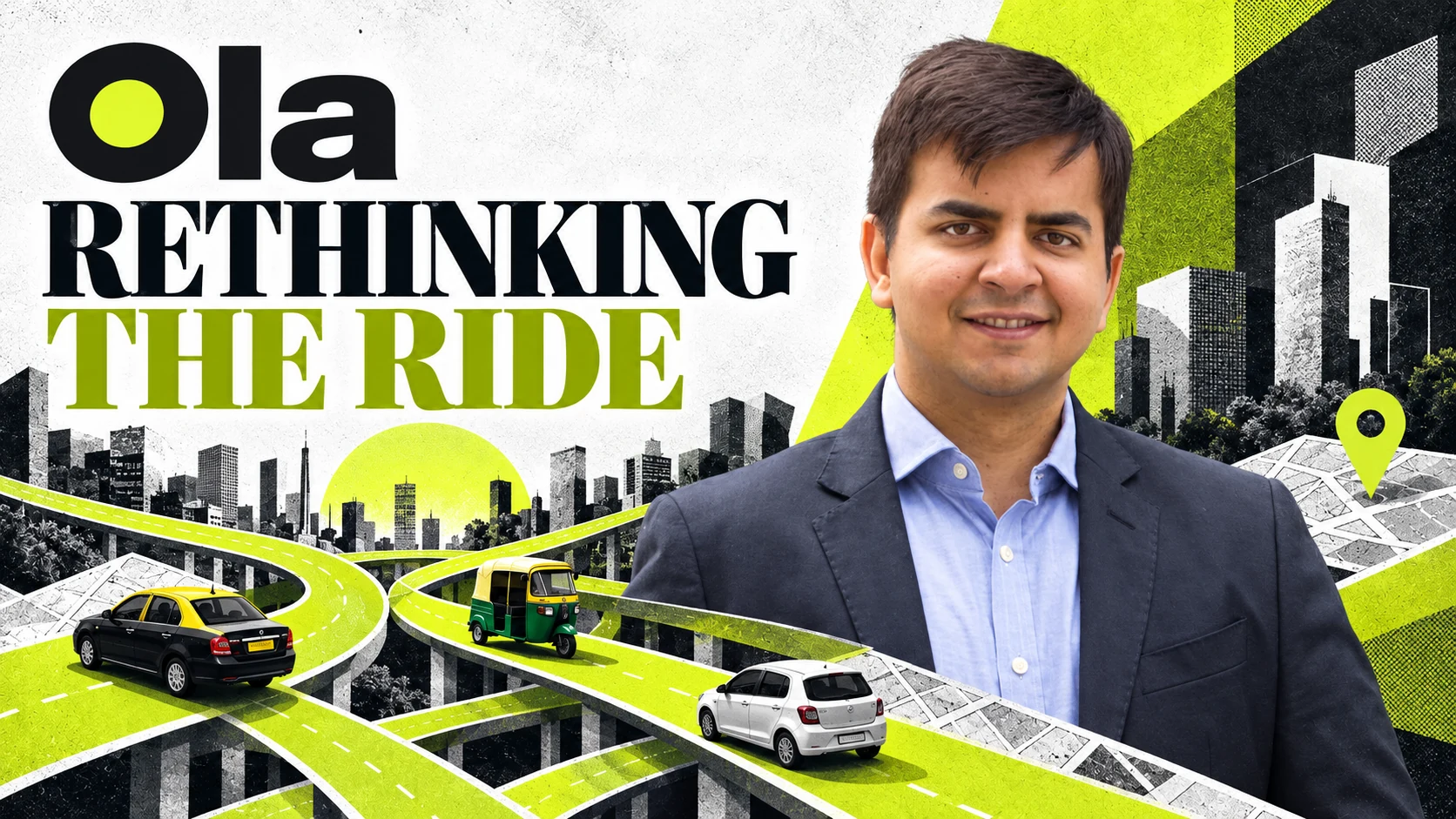
A rider sees a destination and a booking screen. A mobility company has to connect that request with a vehicle, a driver and a workable journey. Bhavish Aggarwal and Ankit Bhati founded Ola in December 2010, building a business around this everyday coordination problem.
Technology meets the street
Ola’s company history identifies Aggarwal’s earlier work at Microsoft Research and describes a service linking customers with drivers across several vehicle categories. The essential idea is understandable without a market-share claim: make transport easier to discover and arrange through a common interface.
The marketplace has two experiences
The person requesting a ride and the person providing it experience different constraints. A clear price, a useful pickup location and dependable communication matter to both. The service also operates in a changing physical environment, where traffic, local rules and supply cannot be simplified away by interface design.
The founder lens
Our interpretation of the Ola journey is that coordination itself can be a product. The harder question is how the product behaves when its participants have competing needs. A founder studying mobility should look beyond the completed booking to the full sequence of waiting, meeting, travelling and resolving problems. That is where a service earns its place in a daily routine.
A match is the beginning of the service
A marketplace can record an accepted booking while the passenger and driver are still struggling to find one another. That gap is a useful place for a founder to investigate. Location descriptions, cancellation reasons and expectations at pickup can matter as much as the original matching decision. Look at the experience from both sides rather than treating one participant as background infrastructure. Increasing demand without understanding local availability may create more disappointed customers; increasing supply without useful trips may create a different problem. The operating challenge is to coordinate a service in a particular place and time, with clear responsibilities when the expected journey does not happen.
Put the idea to work
Use these questions to investigate the idea in your own context.
- Map the steps between an accepted booking and an actual pickup.
- Review cancellation reasons from both passenger and service-provider perspectives.
- Make the support route understandable before an exception occurs.
A closer look
Why study Ola as an operating business as well as an app?
The app helps organise the ride, but the service happens on streets and involves people making real-time decisions. The founder lesson is to investigate the handovers that connect the interface to the outcome promised to the customer.
Sources & editorial note
This profile draws on the public sources below. Company and founder accounts describe their own perspective. Our analysis, questions and takeaway are editorial interpretation. This is not an original interview or a sponsored feature.
See our editorial standards or request a correction. For another perspective, read What an incubator brings to the table.