The story in brief
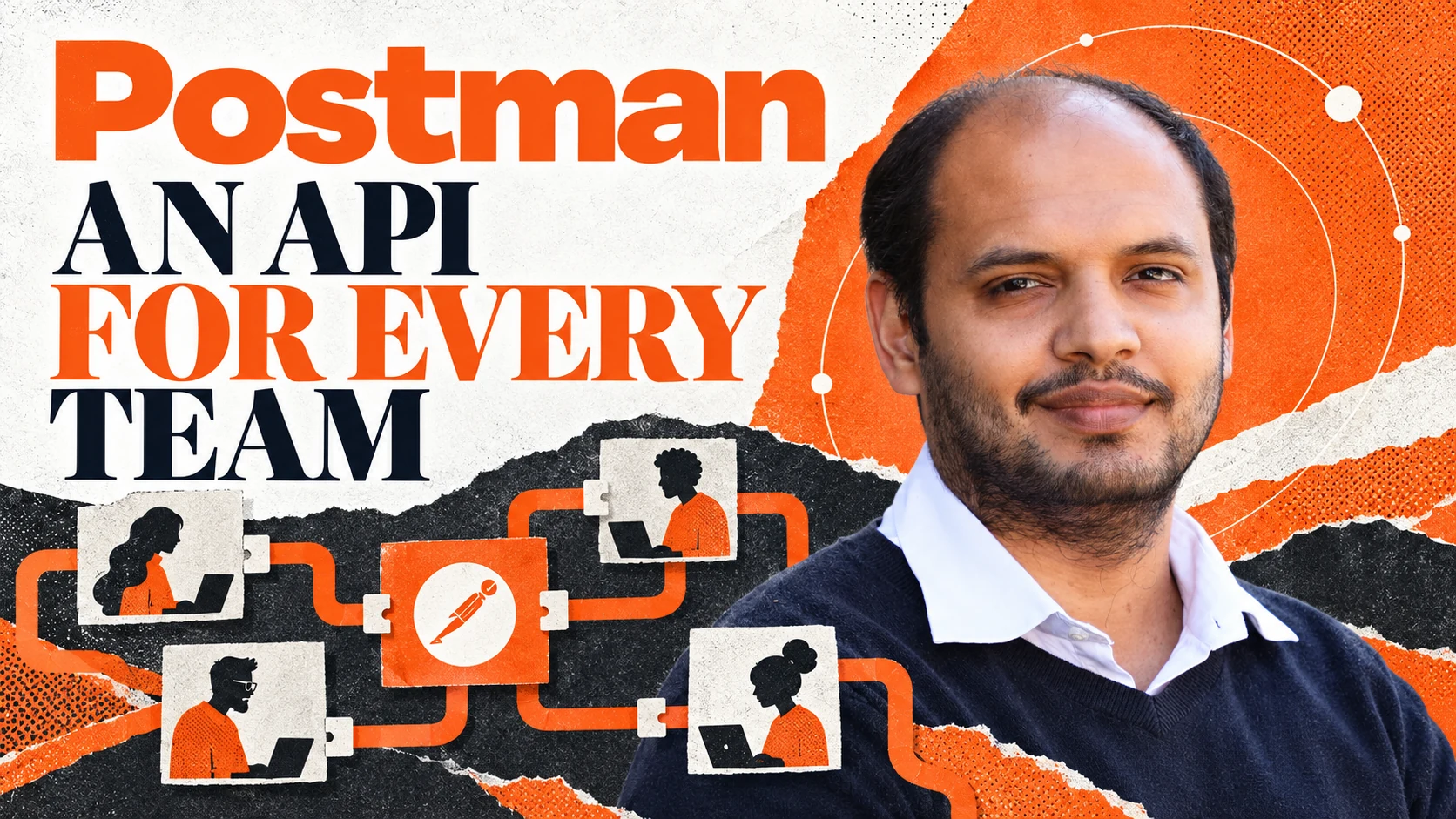
Postman’s origins show a developer tool growing beyond an individual workaround. Sharing, documentation and coordination become product needs as more people depend on the same API work.
Abhinav Asthana encountered the difficulties of working with APIs during his engineering career, including at Yahoo. Postman began as a tool to make testing and debugging easier. Its public company history describes a free application that developed into a business when Asthana, Ankit Sobti and Abhijit Kane launched Postman Inc. in 2014.
An individual task becomes collective
An API connects software systems, but the work around it also connects people. Someone designs the interface, someone tests it, and another team needs to understand how to use it. Postman’s evolution into a collaboration platform makes that wider working context visible.
Adoption starts with usefulness
A developer tool has to justify the interruption of an existing workflow. Clear documentation, a quick first success and predictable behaviour can matter as much as the breadth of the feature list. When the tool becomes shared, teams also need ways to keep knowledge consistent across projects and colleagues.
The founder lens
Asthana’s story invites founders to study where an individual workaround points to a collective problem. The first user may want to complete a task faster; the organisation may need everyone to complete it coherently. Those needs are related, but a product must earn its place at each level.
Notice when personal work becomes shared work
A tool can be useful to one engineer without yet solving a team’s problem. Once colleagues share requests, tests and explanations, they need to know what has changed and which version to trust. That transition creates requirements around organisation and collaboration. A founder should observe how users pass work to each other before adding a large collection of team features. What do they copy manually? Where does context disappear? Which steps make a new colleague dependent on the original author? The opportunity is to preserve the immediacy of an individual tool while making shared work easier to understand. Complexity added too early can obscure the original task that attracted users.
Put the idea to work
Use these questions to investigate the idea in your own context.
- Observe how one user shares a useful piece of work with another.
- Identify the context that gets lost during the handover.
- Test whether a new teammate can complete the core task unaided.
A closer look
What is the transition from a tool to a platform?
In this story, it is the shift from helping one person complete an API task to supporting work shared across a team. The term matters only when it describes concrete additional needs, such as collaboration and understandable documentation.
Sources & editorial note
This profile draws on the public sources below. Company and founder accounts describe their own perspective. Our analysis, questions and takeaway are editorial interpretation. This is not an original interview or a sponsored feature.
See our editorial standards or request a correction. For another perspective, read What an incubator brings to the table.