The story in brief
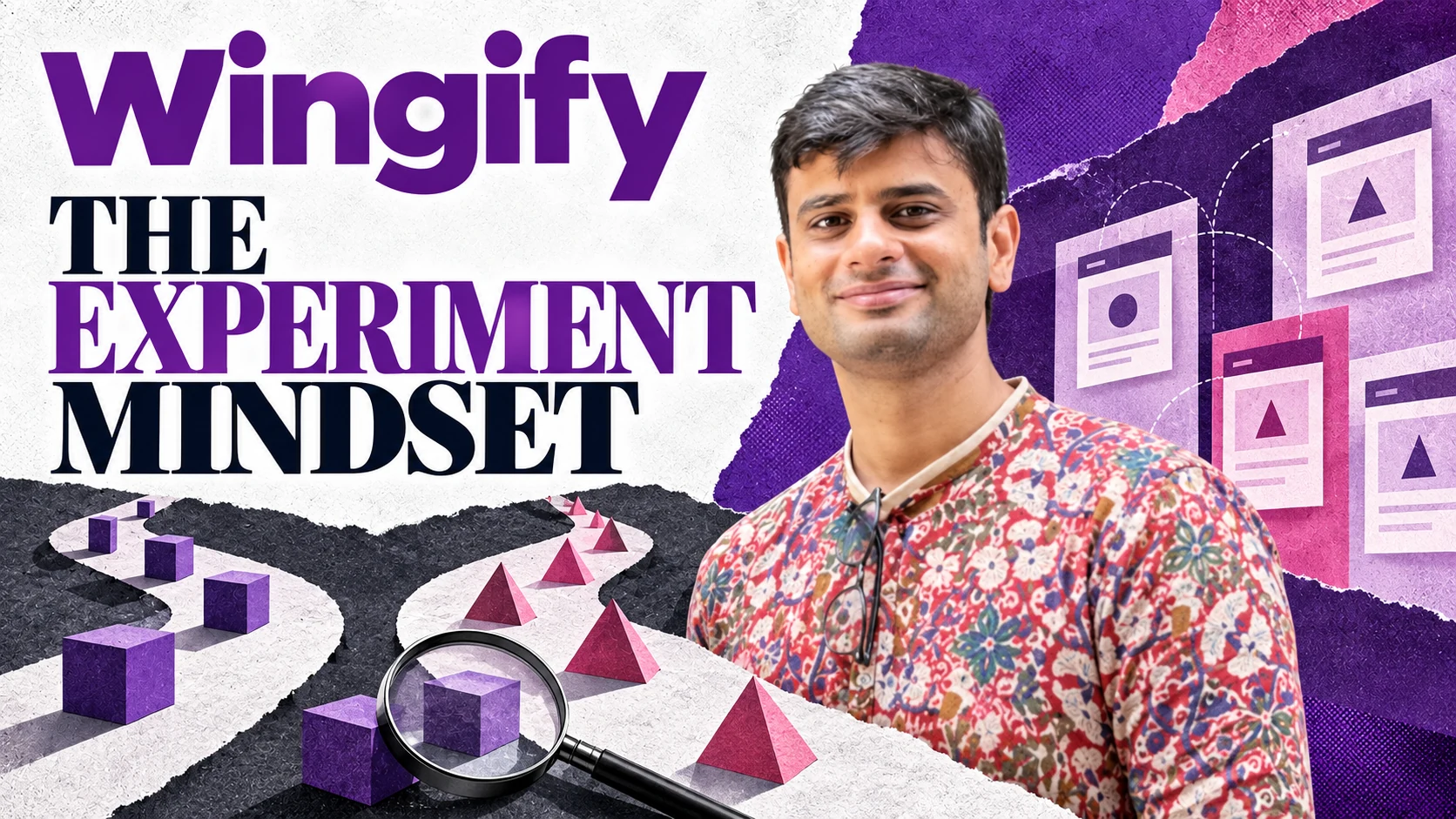
Wingify and VWO provide a founder lens on experimentation. A useful test names a decision, an expected outcome and evidence that could challenge the team’s original assumption.
Paras Chopra’s public biography dates Wingify’s beginning to early 2009. His stated aim was to help businesses improve experiences on websites and applications. VWO, the company’s experimentation platform, grew around testing changes rather than assuming that a persuasive design idea would necessarily help customers.
A decision needs a comparison
Experimentation makes a product decision more specific. A team must name the change, identify the intended outcome and decide what evidence would be meaningful. The result may challenge the original story. That possibility is part of the value: a test should help a team learn, not merely decorate a decision already made.
The tool cannot supply the question
Software can help organise an experiment, but it cannot make an unclear business question precise by itself. Teams still need to think about who encounters the change, what else is happening and whether the outcome matters beyond a convenient metric. A result is useful only within an understood context.
The founder lens
Our interpretation of Chopra’s journey is that a method can become a product when it makes useful work easier to repeat. For another founder, the lesson is to separate conviction from certainty. A strong idea can justify an experiment while leaving room for the evidence to change the next step.
Decide what you will learn before changing the page
A test becomes less useful when its explanation is invented after the result arrives. Write the hypothesis in advance and connect it to the customer problem. A clearer form might help completion, for example, while also changing the quality of the information received. Looking at only one convenient measure can hide that trade-off. A founder should also ask whether the proposed test has enough activity and a sufficiently stable setting to support an interpretation. Where it does not, observation and interviews may be more informative. Experimentation is a discipline of learning; a dashboard does not remove the need for careful judgement about what the evidence can support.
Put the idea to work
Use these questions to investigate the idea in your own context.
- Write the decision and expected customer benefit before a test.
- Choose an outcome measure and a possible unintended effect.
- Record what result would make you reject the original idea.
A closer look
Is every product change suitable for an A/B test?
No. The available activity, context and decision determine whether a comparison will be informative. This profile introduces an evidence-seeking mindset; it does not provide a statistical analysis plan or claim that a test can settle every product question.
Sources & editorial note
This profile draws on the public sources below. Company and founder accounts describe their own perspective. Our analysis, questions and takeaway are editorial interpretation. This is not an original interview or a sponsored feature.
See our editorial standards or request a correction. For another perspective, read What an incubator brings to the table.