The story in brief
Zepto’s founder story turns a rapid-delivery promise into an operating question. Preparation before the order, accurate information and coordination determine whether the experience is repeatable.
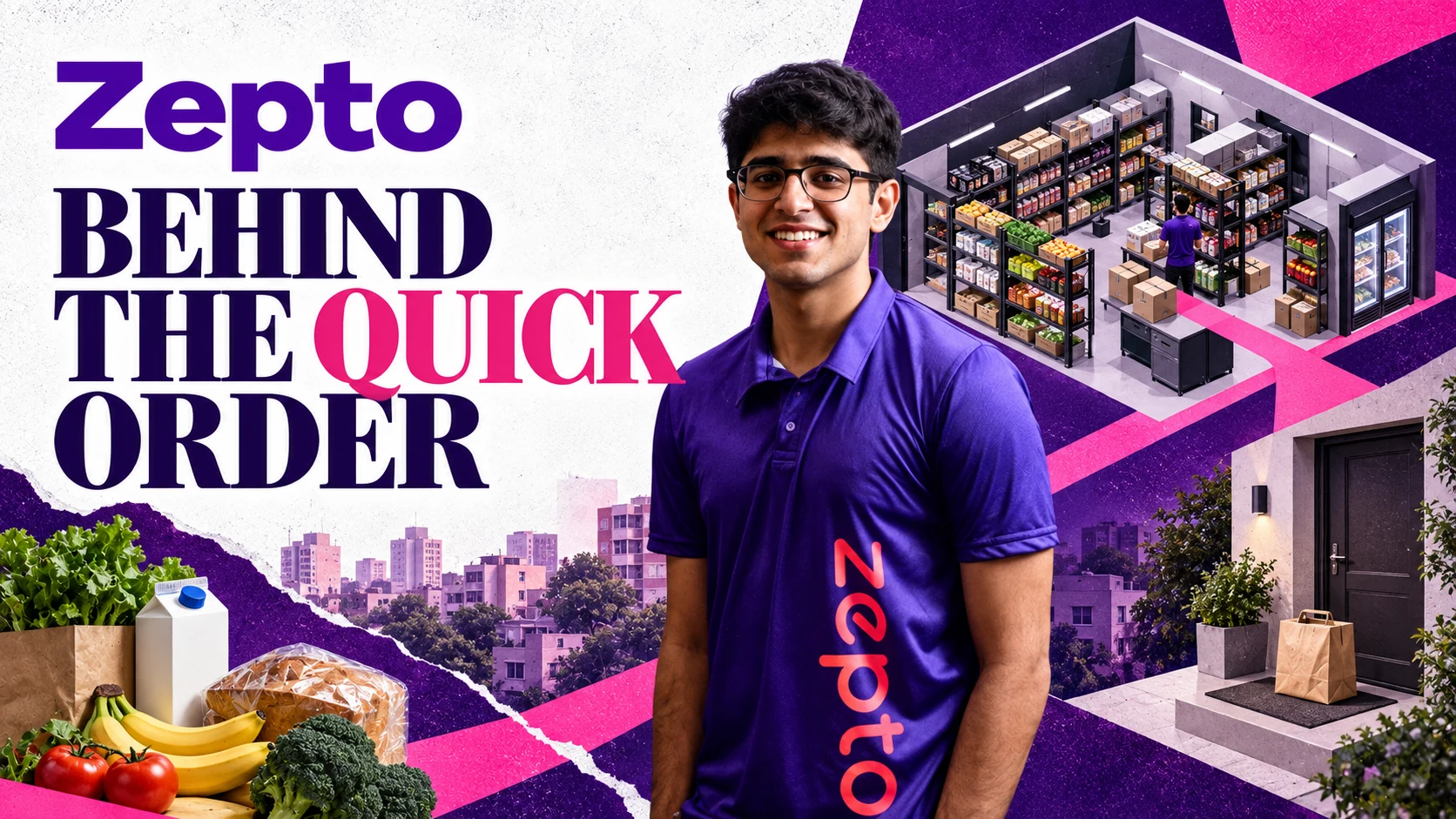
Aadit Palicha and Kaivalya Vohra are the founders of Zepto, listed by Y Combinator in its Winter 2021 batch. The company is presented there as a rapid grocery-delivery venture. The interesting company-building question lies underneath the short customer promise: what has to be ready before an order arrives?
Speed begins before checkout
A grocery service must know which items are available, where they are stored and how an order can be assembled. The experience also depends on an accurate address and a workable delivery route. These are connected operating decisions. Improving one step while leaving another uncertain may not improve the customer’s actual experience.
A promise needs ordinary-day reliability
A founder can demonstrate an exceptionally quick delivery under favourable conditions. A business needs to understand how its service behaves across many orders and changing circumstances. Accurate communication when conditions differ is part of trust, alongside the speed achieved when everything goes smoothly.
The founder lens
Our reading of Palicha’s venture is to treat a striking customer proposition as the beginning of operational design. Break the promise into the work required to deliver it, then identify which parts are repeatable and which remain sensitive to local conditions. The same approach applies beyond grocery to any service selling convenience under time pressure.
Speed begins before the customer taps
The visible countdown begins after an order, but much of the work shaping the result happens earlier. Stock must be placed, information kept usable and the sequence of tasks understood. A founder can learn by mapping what must already be true for a promise to be feasible. This separates improvements in preparation from pressure placed on the final delivery step. It also highlights trade-offs between assortment, availability and operational complexity. Review the full experience, including missing items and the response to an exception. A short delivery time on one order does not explain whether the underlying process is dependable across ordinary variations in demand and location.
Put the idea to work
Use these questions to investigate the idea in your own context.
- List the conditions that must be ready before accepting an order.
- Find delays in preparation and handovers across the full process.
- Review accuracy and customer recovery alongside delivery time.
A closer look
What should founders study behind a speed-based promise?
Study the preparation and coordination that make the promise possible, then examine exceptions. The Zepto profile does not verify a universal delivery time or infer that speed alone demonstrates a sustainable operating model.
Sources & editorial note
This profile draws on the public sources below. Company and founder accounts describe their own perspective. Our analysis, questions and takeaway are editorial interpretation. This is not an original interview or a sponsored feature.
See our editorial standards or request a correction. For another perspective, read What an incubator brings to the table.